

QF_UFLRA Model-Guided Performance Plan#
The authoritative description of current solver behavior is Nelson-Oppen theory combination. This page retains performance evidence, implementation history, rejected experiments, and remaining optimization work; its dated milestone descriptions are not the current architecture reference.
Status stamp: 2026-08-12, branch qf-uf-structural-preprocessing, after the
convex model-reconciliation implementation, exact-commit fuzz and model gate,
full 120-second QF_UFLRA reference comparison, and full 300-second pure-QF_LRA
main-merge regression comparison.
This note records the next performance plan for the mixed QF_UFLRA solver after the EUF-forbidden final-arrangement pruning change. It is an implementation checklist, not a claim that Primo already implements full model-based theory combination.
The clean-room sources for the intended direction are:
Leonardo de Moura and Nikolaj Bjorner, “Model-based Theory Combination”, Electronic Notes in Theoretical Computer Science 198(2), 2008, pp. 37-49;
Nikolaj Bjørner and Lev Nachmanson, “Arithmetic Solving in Z3,” CAV 2024, Sections 3.2 and 6, with the local audit in
docs/papers/arithmetic-solving-in-z3.md;the local audit in
docs/papers/model-based-theory-combination.md;the current Nelson-Oppen design note in
docs/papers/nelson-oppen-closure-methods.md;current benchmark evidence recorded in
docs/run-log.json.
Current Evidence#
Complete convex reconciliation result, 2026-08-10. Commits 9bed48e,
7d907f7, and bbd43b9 completed the then-opt-in convex QF_UFLRA checklist
below. The ccdd71a retained-epoch evaluation supplies the later default
promotion evidence.
The implementation adds all four Section 5.1 LRA equality producers, a full
scratch candidate assignment with Section 5.2 mutation, SAT-false equality
separation, checkpointed EUF compatibility projection, one causal
positive-first equality assumption, and direct output of the accepted combined
model. EUF-only Real classes receive fresh model representatives without
entering Nelson-Oppen arrangement search.
The exact bbd43b9 binary passed 3,000 generated mixed cases against Z3 and
1,000 finite-domain cases against Z3 and cvc5. All 11 tracked QF_UFLRA seeds
passed deterministic preflight. A complete 100-mutation-per-seed YinYang run
processed all 11 seeds with zero invalid seed or bug trigger. A separate deeper
campaign reached 39,320 differential solver calls with zero bug files before it
was stopped: cumulative mutations of a late Boolean seed made both Primo and Z3
time out, so that run is additional partial coverage rather than evidence that
every configured mutation completed. Local Dolmen validation accepted all 611
SAT models among 1,000 generated cases; the other 389 cases were UNSAT.
That 611-model run was the last external model gate before the later live-EUF,
care-scope, and combination-scan work. The generated SLURM harness used for
those later changes compared verdicts but did not request models, and the full
1,284-file performance harness likewise ran without get-model. Consequently,
those answer campaigns were not current-model evidence. The permanent mixed
gate now validates its general and finite-domain QF_UFLRA cases with Dolmen,
and scripts/slurm_qf_uflra_model_validation.sbatch supplies separate
real-corpus coverage.
The first exact direct-Dolmen cluster run of that permanent gate exposed a
missing concrete-model invariant rather than a theory-answer disagreement.
Three generated SAT witnesses had shared Real arguments that were distinct as
symbolic DeltaRational values but equal again after model printing chose
delta = 1. The accepted repair applies the Section 3.3 crossing bounds to
adjacent sorted shared values in the mixed coordinator, without changing LRA
solving. At exact commit 2b26aa6, the fresh generated gate passed 3,000
general answer comparisons, 1,000 finite-domain comparisons, and all 2,081
satisfiable model checks directly with Dolmen; the other 1,419 generated cases
were unsatisfiable. The companion 20-file real sample then found a separate
printer defect in three SAT models: a stale pre-rewrite Real application table
row could shadow the exact value of the active purified application with the
same concrete arguments. The follow-up repair assigns every Real-valued
application in a purified EUF class and gives exact application rows precedence
during table deduplication. The five MathSAT sample rows require Dolmen’s
lenient parser for compound linear multiplication, so the real-corpus gate uses
--strict=false while the generated gate remains strict.
The fresh exact-commit rerun at 4dca518 supplies the model-correctness merge
evidence. SLURM job 125327 passed 3,000 general answer comparisons and 1,000
finite-domain comparisons, then checked all 2,137 satisfiable generated models
directly with Dolmen; the other 1,363 generated cases were unsatisfiable.
SLURM job 125328 completed the deterministic 20-file real-corpus sample: all
17 satisfiable models passed direct Dolmen validation and the other three cases
were unsatisfiable. Both jobs completed every shard with no fallback, model
error, wrong answer, crash, timeout, parser/type error, unsupported result, or
saved bug. These results validate the implemented convex QF_UFLRA path and its
model composition; they do not claim the generic DPLL(T^M) transition system.
Main-merge validation, 2026-08-12. Commit 35ac160 merges the then-current
main revision 626c7e5 into the QF_UFLRA branch without a conflict or an LRA
behavior change. A fresh exact-commit gate passed 3,000 generated mixed cases,
500 finite-domain QF_UF cases, and 500 finite-domain QF_UFLRA cases. Dolmen
directly accepted all 2,098 satisfiable models among the 3,500 model rows; the
other 1,402 rows were unsatisfiable. Every shard and metadata record completed,
with no wrong answer, model error, crash, timeout, unsupported result, reference
disagreement, or saved bug.
The pure-QF_LRA merge comparison used all 1,753 files in
benchmarks/qf-lra-full-division.txt, a 300-second per-file timeout, and exact
Release binaries for 626c7e5 and 35ac160 in one paired SLURM array. Main
solved 1,658 files and the candidate solved 1,657, both with zero wrong answers,
errors, or decisive-answer disagreements. The only loss was a LassoRanker row
that main completed in 297.2 seconds while the candidate reached the 300-second
cutoff. All 1,657 commonly solved rows have identical non-time statistics.
Their aggregate runtime improved from 21,685.8 to 21,484.8 seconds; among the
590 rows where main took at least one second, the median candidate/main ratio
was 0.9965 and no row differed by 30 percent. This is accepted as cutoff churn,
not reported as exact solved-count parity. A preceding 237-file stratified run
had identical 202-file solved coverage, identical non-time statistics on every
commonly solved row, and a 2.5 percent aggregate timing improvement.
On the full 1,284-file QF_UFLRA corpus at 30 seconds per file, the new profile
solved 1,257 files with 27 timeouts, zero errors, unsupported rows, or wrong
answers, and PAR2 2,092.497309. The 1f3d81c baseline solved 1,238 with 46
timeouts and PAR2 3,306.995737. All 19 differences were timeout recoveries;
there were no losses or decisive-answer disagreements. Common-solved aggregate
time fell from 546.995737 to 316.577621 seconds. CPAchecker BMC improved from
5/15 to 7/15, CPAchecker induction from 323/359 to 340/359, and MathSAT stayed
900/900 while its aggregate time fell from 74.297800 to 61.867465 seconds.
The intended mechanism is active: 739 rows converged without the broad exact scan, 386 rejected EUF congruence-producing edges were materialized as lazy splits, and only one row used the conservative exact fallback because two LRA interface terms were unmapped. Exact fallback probes fell from 1,133,771 to 210. The tradeoff is more SAT work: decisions rose from 3,958,867 to 7,316,844, propagations from 60,226,688 to 68,470,250, and solve calls from 2,165 to 3,562. The expensive tableau-probe removal nevertheless dominates wall time. At that milestone the profile remained opt-in: the reused Yices 2.7.0 30-second result still solved 1,276 files with eight timeouts and PAR2 590.699880, so a large performance gap remained. The retained-epoch result below supplies the later default-promotion evidence.
Normalized-interface repair, 2026-08-10. The one exact-fallback row did not
contain missing arithmetic variables. One Real constant occurred syntactically
in both theories but cancelled from every normalized LRA polynomial, and was
counted twice across two model-partition builds. Shared-interface discovery now
uses normalized LRA variables. On
mathsat/RandomDecoupled/pb_real_50_100_30_09.smt2, the interface falls from 95
to 94 terms, cumulative unmapped observations from two to zero, exact probes
from 156 to zero, and reconciliation converges normally. A fresh local
1,000-case mixed differential gate passed against Z3. The subsequent exact
ccdd71a fuzz and full-corpus runs include this repair and supply its promotion
evidence.
Batched split-frontier prototype, 2026-08-10. Reconciliation now scans the rest of the deterministic LRA spanning presentation after one optional merge is rejected. It rolls back all temporary model merges, canonicalizes the rejected edges, lazily materializes them, and activates them as one IPASIR-UP assumption batch. These are speculative model choices, not entailed equalities; only the backend’s failed-assumption set produces a blocking clause. The round worklist also canonicalizes reason literals and retains the shortest independently valid reason when multiple producers publish the same equality.
An exact local comparison against 6b68628 on the 20 executable rows in
benchmarks/qf_uflra-smtlib-sample-5-per-family.txt reduced SAT solve calls from
30 to 27, decisions from 18,468 to 17,016, propagations from 86,842 to 82,123,
and aggregate wall time from 1.109476 to 0.880448 seconds. Three frontier batches
contained five rejected edges. This is directional local evidence only; the
fresh fuzz gate and full SLURM comparison remain the acceptance bar.
Retained augmented-LRA epoch prototype, 2026-08-10. The full-corpus
bbd43b9 artifact contains 2,241 augmented LRA preparations across 274 files.
MixedLraModelEpoch now retains one such preparation and checked tableau while
the exact set of true generated interface equalities is unchanged. A different
component assignment pops all old bounds to checkpoint zero and asserts the new
bounds on the retained feasible basis. A changed interface key rebuilds the
epoch. This uses the existing Dutertre-de Moura bound-backtracking invariant; it
does not add rows dynamically, mutate the live base LRA callback tableau, or
affect pure QF_LRA.
On cpachecker-induction.ddv_machzwd_inw_false-unreach-call.i.smt2, three exact
Release runs improved from 0.86–0.90 seconds to 0.53–0.55 seconds. SAT solve
calls, decisions, and propagations stayed exactly 87, 258,029, and 558,081.
Augmented preparations fell from 86 to 13 and the retained tableau served 73
new assignments. The 20-row local sample kept the same search counters and
improved aggregate time from 0.880448 to 0.855104 seconds. ddSMT reduced the
mechanism witness to one Real constant, one unary Real function, and one
disjunction; focused tests exercise it under both Sparse and SOI pivoting.
The exact-commit SLURM evaluation at ccdd71a passed 3,000 generated mixed
cases, 1,000 finite-domain cases, all 11 deterministic seeds, and the complete
100-mutation-per-seed gate with no disagreement, crash, unsupported result, or
saved bug. On the 1,284-file, 30-second corpus, the retained epoch solved 1,264
files with 20 timeouts and PAR2 1,692.677561. The prior accepted reconciliation
profile solved 1,257 with 27 timeouts and PAR2 2,092.497309; the old default
solved 1,238 with 46 timeouts and PAR2 3,306.995737. The epoch had seven
recoveries and no losses against the prior profile, and 26 recoveries and no
losses against the old default. Common-solved time against the old default fell
from 546.995737 to 276.354906 seconds.
Batching and retention also reduced the prior reconciliation profile’s SAT
solve calls from 3,562 to 3,092, decisions from 7,316,844 to 6,705,117, and
propagations from 68,470,250 to 66,110,064. There were 793 augmented preparation
misses and 976 retained-tableau reuses across 130 files. This evidence promotes
convex model reconciliation to the QF_UFLRA default. The explained exact path
remains available through --no-qf-uflra-model-reconciliation and as the
automatic fallback for failed candidate invariants.
The exact promoted-default revision 4e19d1b then passed the same campaign
without an enable flag: 3,000 mixed cases, 1,000 finite-domain cases, all 11
seed preflights, and 100 successful mutations per seed, with no disagreement or
saved bug. Its 30-second full-corpus run has the same 1,264 solved files and 20
timeouts as explicit ccdd71a. Every solved row has identical answer and
non-time statistics; aggregate solved-row time changed from 492.677561 to
470.517558 seconds. One already-timeout 94 MB CPAchecker row aborted while the
benchmark’s async-unsafe SIGTERM handler tried to flush statistics under high
memory pressure. A hard-kill controlled probe reproduced the extreme memory
growth without that handler abort. This is recorded as timeout-infrastructure
and memory triage, not hidden as a clean timeout or counted as a solved-set
regression.
Mixed row-propagation A/B, 2026-08-10. On the same deterministic 20-row
sample, enabling only --lra-row-propagation preserved all 20 answers and all
27 SAT solve calls while reducing SAT decisions from 17,016 to 8,070 and SAT
propagations from 82,123 to 65,816. Nine files used 1,149 forward row
propagations. Adding --lra-bidirectional-row-propagation produced only 38
reverse propagations on three files and did not improve aggregate time. Forward
row propagation therefore advanced to the full-corpus A/B as a mixed candidate.
The 1,284-file run kept the same 1,264 solved count and reduced PAR2 from
1,692.677561 to 1,647.364553, but exchanged one solved file for one timeout and
one timeout for one solve. It remains opt-in; the global forward and reverse
defaults are unchanged.
Section 5.2 integration result, 2026-08-09. The merged LRA prerequisite
provides freedom_interval() and
diversify_shared_model(). The mixed coordinator now runs one scratch sweep per
feasible round when model reconciliation or model-equality branching is enabled,
projects the post-mutation classes once, and reuses them for reconciliation,
exact convex candidate filtering, and optional branch selection. This removes
the former two-fresh-solves-per-pair mutation proxy. The pre-mutation pair count
is computed from class cardinalities, so only post-mutation pairs are
materialized.
The soundness boundary is explicit: a pair left equal by the greedy sweep is not called forced. Only explained opportunistic producers or exact convex fallback may publish an entailed equality. Reconciliation treats the scratch assignment as a model candidate: SAT-false pairs must be separated, and EUF must absorb all spanning edges and their congruence consequences. Accepted model output uses that same candidate assignment rather than rebuilding a different tableau.
Fresh SLURM gates at commit 4937d3c passed 4,000 generated cases with
reconciliation and another 4,000 with model-equality branching. Each option set
covered 3,000 generated mixed cases plus 500 finite-domain QF_UF and 500
finite-domain QF_UFLRA cases, with no wrong answer, timeout, crash, unsupported
result, parser/type error, or reference disagreement. The reconciliation and
branching YinYang runs then each processed all 11 compact QF_UFLRA seeds. They
made 43,982 and 43,872 differential solver calls respectively, with no invalid
seed or bug trigger.
On the same-commit 1,284-file QF_UFLRA reconciliation ablation at five seconds per file, mutation on and off both solved 1,156 files with 128 timeouts and zero wrong answers or answer/status differences. The scratch sweep removed 2,280,171 of 11,450,940 model-equality candidate pairs. SAT decisions fell from 1,388,580 to 1,281,729, propagations from 24,996,441 to 24,718,750, and solve calls from 2,199 to 2,169. PAR2 fell from 1,419.782409 to 1,412.285038; solved-row time fell from 139.782409 to 132.285038 seconds. The unchanged Z3 result remains 1,234 solved, 50 timeouts, and PAR2 758.708455.
The 45-file, 60-second sample gives the same policy decision. Reconciliation
solved 43 files both with and without mutation; PAR2 changed from 275.807627 to
271.117621. Model-equality branching solved only 37 files in both variants,
although mutation reduced its PAR2 from 1,034.190677 to 991.359031. The reused
Z3 result solved all 45 with PAR2 10.936763. Mutation therefore remains enabled
within the reconciliation and branching profiles, with
--no-model-equality-mutation retained as an ablation. This result alone did
not promote either profile; the later retained-epoch evidence promotes convex
reconciliation while model-equality branching remains opt-in.
Care-scoped mutation result, 2026-08-12. The default scratch sweep still
receives every mapped shared Real variable. The opt-in
--model-equality-mutation-scope=care specialization instead passes only
current EUF care-pair endpoints to the unchanged LRA mutator. The coordinator
then reconstructs the complete shared-value partition from the returned full
assignment. It rejects an attempted mutation if that partition contains more
candidate pairs than the original model, so the restricted sweep cannot trade
a local care improvement for additional global candidate equalities.
The exact implementation passed 3,000 generated mixed cases, 500 finite QF_UF
cases, 500 finite QF_UFLRA cases, all 11 deterministic seeds, and 100 YinYang
mutations per seed with no bug trigger or reference disagreement. At five
seconds on all 1,284 QF_UFLRA files, care solved 1,247 versus 1,242 for the
same-commit all scope, with six recoveries, one loss, no answer disagreement,
and PAR2 539.428890 versus 592.164651. At 30 seconds both solved 1,267, with two
recoveries and two losses; care reduced common-solved time from 564.657864 to
451.026811 seconds and PAR2 from 1,593.277162 to 1,502.067240.
The mechanism is not an unqualified search win. In the 30-second run, scoped
mutation visits fell from 524,902 to 182,213 and attempted updates from 44,624
to 19,482, but SAT decisions rose from 8,377,635 to 8,928,243 and compatibility
projection terms from 71,369,784 to 87,447,114 because the model choices changed
the subsequent search. Two attempted care mutations were rejected by the
global pair guard. The option is retained as a validated performance mode; the
default remains all because the solved-set exchanges and increased SAT work
need broader policy evidence before promotion.
Full reference comparison, refreshed 2026-08-14. The original 120-second
full-corpus comparison at commit 9061611 ran all six profiles over the same
1,284 QF_UFLRA files. The table and plot below replace only the default Primo
all result with the current-main rerun at 413179b; the care and reference
rows reuse the unchanged 2026-08-12 artifacts:
Solver/profile |
Solved (sat/unsat) |
Timeouts |
Solved-row time (s) |
PAR2 |
|---|---|---|---|---|
Primo |
1,272 (761/511) |
12 |
816.81 |
3,696.81 |
Primo |
1,272 (761/511) |
12 |
832.63 |
3,712.63 |
Primo |
1,271 (760/511) |
13 |
660.98 |
3,780.98 |
Z3 5.0.0 |
1,254 (752/502) |
30 |
617.39 |
7,817.39 |
cvc5 1.3.4 |
1,273 (762/511) |
11 |
966.15 |
3,606.15 |
OpenSMT 2.9.2 |
1,265 (754/511) |
19 |
1,374.83 |
5,934.83 |
Yices 2.7.0 |
1,276 (765/511) |
8 |
75.77 |
1,995.77 |
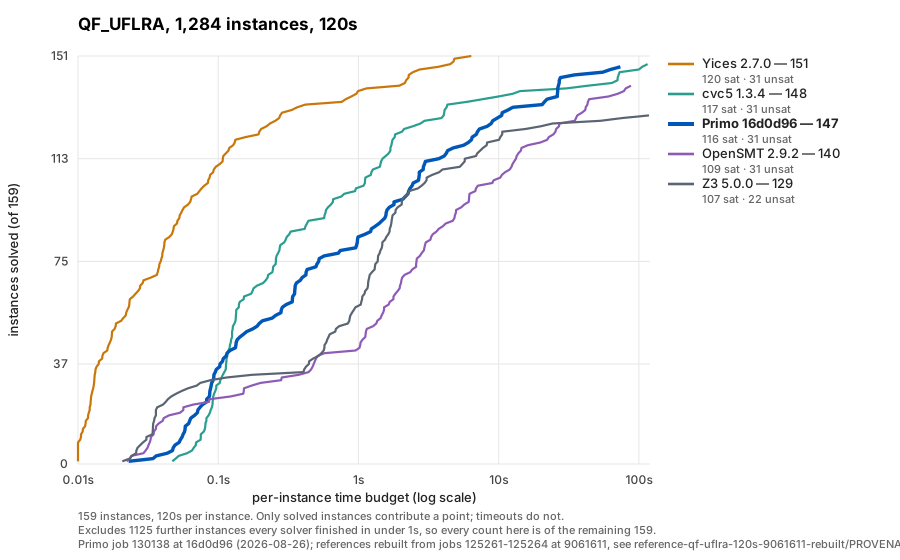
Fig. 8 Instances solved against the per-instance time budget on the 159 instances
that at least one solver did not finish within one second (160 at the
2026-08-14 reading; one instance crossed the one-second line). The 1,125 common
easy instances are omitted from every series, so all pairwise vertical gaps are
preserved. Legend counts refer to this retained subset; the table above reports
the complete 1,284-file corpus. Legend entries are sorted by solved count, and
the heavier blue line marks the default Primo all profile. Primo comes from
the 2026-08-26 SLURM job 130138 at 16d0d96; Z3, cvc5, OpenSMT, and Yices are
jobs 125261–125264 at 9061611, rebuilt from their logs (see above). Legend
entries carry each solver’s sat/unsat split below the total. The opt-in Primo care profile remains in the
table as historical policy evidence but is omitted from this reference-solver
comparison.#
2026-08-26 refresh at 120s, and a recovered reference set#
Primo all at 16d0d96 scores 1,272 (761/511) with zero wrong answers –
identical to 413179b’s solved set, which is the expected outcome: everything
merged since is QF_LIA machinery this fragment never enters. Solved-row time
moved 832.63 -> 816.81 seconds (1.9% faster) and PAR2 3,712.63 -> 3,696.81,
the same order as the run-to-run variation the 2026-08-14 refresh already
documented below, and in the same direction the pinned-CPU A/B there found.
The reference CSVs had to be recovered before this plot could be drawn.
The directory jobs 125261–125264 wrote to no longer exists, and the first
conclusion drawn from that – recorded here briefly, and wrong – was that the
120s comparison could not be refreshed at all. It could: sacct still names
the jobs’ working directory, and bench_qf_uf_full.py prints one progress line
per instance carrying file, family, status, answer and elapsed seconds. All
four solvers’ logs were complete, 1,284 lines each, zero unparsed. The CSVs
were rebuilt from them into
slurm-results/reference-qf-uflra-120s-9061611-rebuilt/, with expected and
wrong recomputed from each benchmark’s own set-info :status rather than
assumed, and the columns a progress line cannot carry left empty rather than
guessed. The rebuilt counts reproduce the table above digit for digit, which is
what establishes they are the same data. See that directory’s PROVENANCE.txt.
The lesson generalises past this figure: a vanished results directory is not
the same as vanished results, and find over directory names is not a search
for the data.
Regenerate the figure from the campaign’s copied shard directories with:
python3 scripts/plot_cactus.py \
  --series "Primo all=<current-primo-root>/primo-all" \
  --series "Z3=<reference-root>/z3" \
  --series "cvc5=<reference-root>/cvc5" \
  --series "OpenSMT=<reference-root>/opensmt" \
  --series "Yices=<reference-root>/yices" \
  --timeout 120 --drop-solved-by-all-under 1 \
  --sort-by-solved --highlight-series "Primo 3c2fbf1" \
  --title "QF_UFLRA, 1,284 instances, 120s" \
  --note "Primo job 130138 at 16d0d96; references rebuilt from jobs 125261-125264 at 9061611." \
  --out docs/_static/qf-uflra-cactus.svg
The current rerun has exactly the old Primo solved set: 1,272 common solves, no
recoveries, no losses, and no answer disagreements. Its aggregate solved-row
time increased from 805.38 to 832.63 seconds (3.4 percent), mostly in the
MathSAT family (70.67 to 100.13 seconds). A follow-up pinned-CPU local A/B used
identical Release builds of 9061611 and 413179b. Across 40 MathSAT rows,
including the 20 largest apparent cluster regressions, summed five-run medians
changed by only 0.5 percent (1.624 to 1.632 seconds). Ten longer rows changed by
0.8 percent over seven-run medians (1.864 to 1.879 seconds), with equal answers
and search statistics. The old SLURM tasks accumulated CPU time equal to 98.8
percent of elapsed time, versus 93.6 percent in the refresh. The evidence
therefore attributes the aggregate cactus shift to cluster contention, not a
reproduced solver regression; it still does not demonstrate a speedup from the
post-9061611 bookkeeping changes.
This remains the first recorded full-corpus QF_UFLRA comparison in which Primo
materially outperforms Z3 on both coverage and PAR2: current all solves 18
more files and reduces PAR2 by 53 percent. It also solves seven more files than
OpenSMT with a 37 percent lower PAR2. Primo is within one solve of cvc5, but
Yices remains the performance target with four additional solves and roughly
13.8 times lower aggregate time on the 1,272 rows shared with Primo all.
Care reduced aggregate time on the 1,271 common Primo solves from 803.83 to
660.98 seconds, but timed out on one induction row solved by all; this does
not justify changing the default. All profiles had zero wrong answers, errors,
unsupported results, or pairwise decisive-answer disagreements. The exact
commands, job IDs, family counts, and artifacts are recorded in
docs/run-log.json.
Joint Z3/Yices gap triage, 2026-08-12. The 120-second shard artifacts were
also ranked by requiring both Z3 and Yices to solve a row. No Primo timeout met
that condition: Z3 also timed out on all four rows solved only by Yices. Under
the default all scope, 22 solved rows took at least two seconds and at least
twice as long as each reference; 21 were CPAchecker induction rows, one was a
CPAchecker BMC row, and every one was SAT. Taking the faster of all and care
per row leaves four robust gaps:
row (CPAchecker induction) |
best Primo |
Z3 |
Yices |
|---|---|---|---|
|
9.07 ( |
2.14 |
1.96 |
|
9.57 ( |
2.29 |
0.26 |
|
19.10 ( |
5.50 |
2.73 |
|
15.65 ( |
5.73 |
0.20 |
Fresh gprof runs at commit 0b40649 covered the smaller parport row and
the tda18271c2dd and m0...opl3 rows. In those runs,
lra_model_equal_partition() accounted for about 70–80 percent of sampled
cumulative time, almost entirely below LraTableau::diversify_shared_model().
The leading flat-profile work was model-value grouping through repeated SOI
breakpoint sorting and hash-set insertion. The all-scope runs made about 16.7
million, 63.4 million, and 27.7 million such sorting calls respectively. This
does not justify modifying the LRA implementation: the mixed coordinator chooses
the mutation scope and invocation schedule. Care reduced runtime on 21 of the
22 default-scope gaps, but regressed m0...opl3 by increasing solve calls from
6 to 13 and compatibility-projection visits from 3.18 million to 8.40 million.
The next experiment therefore needs an adaptive coordinator policy, not a
blanket switch of the default scope.
Shared-model reconciliation result, 2026-08-09. The repaired opt-in
--qf-uflra-model-reconciliation profile passed 3,000 generated mixed cases,
1,000 finite-domain cases, all 11 tracked-seed preflights, and a YinYang
campaign configured for 2,000 mutations per seed on SLURM. The seed preflight caught an
earlier unsound version: internally merging x = y could also make f(x) = f(y) true by congruence without sending that consequence back to LRA. The
implemented repair keeps such congruence-producing merges on the explained
SAT-visible path.
On the full 1,284-file QF_UFLRA corpus at five seconds per file, the repaired
profile solved 1,156 files with PAR2 1,424.154414, compared with 1,123 and PAR2
2,040.942239 for the same-commit default. It solved all 900 MathSAT files and
242/359 CPAchecker induction files; default solved 893 and 216 respectively.
There were no wrong answers, non-timeout failures, or decisive-answer
disagreements with default or the reused identical-corpus Z3 result. The
profile reduced SAT decisions from 2,646,397 to 1,322,558, propagations from
42,195,478 to 24,815,243, solve calls from 8,348 to 2,177, and SAT-visible
interface equality atoms from 17,730 to 1,161. It absorbed 19,600 explained
equalities internally and used 584 guarded congruence fallbacks with zero
validation or exact-fallback failures. Exact commands, corpus hashes,
scheduler state, and artifacts are in docs/run-log.json.
This accepts the profile as a measured QF_UFLRA experiment, not as the default or as a full implementation of the paper. At that historical commit, a second EUF-to-LRA reconciliation iteration, generic component-model state, and broader logic coverage were missing. The class/worklist milestone below now addresses the round-local congruence-consequence step; generic component-model state and broader logic coverage remain absent. The later Section 5.2 scratch model-mutation integration described below was not included in this historical benchmark result.
Correctness blocker and repair, 2026-08-05. The later full 1284-file QF_UFLRA
5s SLURM run at commit f7c8bd7, recorded as
2026-08-05-qfuflra-full-5s-rejected-unsound-filter, invalidates the
consumer-aware LRA-to-EUF equality-skip experiment as performance evidence. The
candidate-final array produced three wrong sat answers on benchmark rows whose
SMT-LIB status and existing Z3 artifact both say unsat; local repro showed the
default filter path returning sat on the same checked rows. The conservative
repair disables the mergeable-skip optimization: LRA-implied equalities that EUF
can merge are now still forced through the guarded interface-equality clause
path unless EUF already has the pair equal. Performance work on this line is
blocked until the repaired path passes the stronger gate below.
The fuzz evidence that preceded this broad run was insufficient for this
mechanism. The default filter had 1000 generated mixed cases from
scripts/qf_uflra_smoke_fuzz.py with seed 20260806, but that generator uses
small synthetic formulas. The generator now includes a dedicated
bool-arguments shape and the mixed mode samples it alongside the other
QF_UFLRA shapes. The tracked benchmarks/seeds/qf_uflra corpus also contains
Boolean-argument regressions. The opt-in candidate-final path had only a 100-case
smoke run with seed 20260804. Future QF_UFLRA theory-combination benchmarks
must run a merge-grade gate for the exact solver options being evaluated, and
that gate must include real benchmark seeds or saved regressions for the
arrangement/equality mechanism.
The Boolean-argument bridge is deliberately separate from the arithmetic
model-guided scan. It uses canonical EUF true/false terms and SAT clauses
linking each Boolean UF argument to exactly one of them. This makes Boolean UF
congruence available to mixed EUF through ordinary explained closure, without
promoting model coincidences or adding an all-pairs SAT workload.
The older evidence below is historical context only; it is not sufficient to claim the current filter is sound.
The 2026-08-05 SLURM sample at commit 8b3bb4e, recorded in
docs/run-log.json, shows that EUF-forbidden final-arrangement pruning was the
right first repair:
default mode improved from 26/45 solved to 33/45 solved;
opt-in
--qf-uflra-candidate-final-scanimproved from 28/45 solved to 38/45 solved;default model-separation candidates fell from 134245 to 60;
candidate-mode model-separation candidates fell from 204846 to 62;
the run had no wrong answers.
That improvement removes the broad arrangement-separation explosion as the main remaining explanation for the Z3 gap. Z3 still solves all 45 files with PAR2 7.525657, while candidate mode solves 38/45 with PAR2 903.689026.
The follow-up Z3 -st inspection at commit 931598f, recorded as
current-slurm-derived evidence in docs/run-log.json, points at equality
traffic and LRA extra-atom probing:
pb_real_30_60_45_31.smt2: Z3 solves in 0.023797s with 40 conflicts, 72 decisions, and one final check. Primo candidate mode times out after 100144 LRA extra-atom probes, 6807 LRA-to-EUF equalities, 422 equality rechecks, and 4069 forced SAT equality clauses.pb_real_40_80_60_36.smt2: Z3 solves in 0.026763s with 60 conflicts, 122 decisions, two final checks, and one interface equality. Primo candidate mode times out after 60718 LRA extra-atom probes, 2801 LRA-to-EUF equalities, 128 equality rechecks, and 1165 forced SAT equality clauses.CPAchecker
email_spec3_product29: Z3 solves in 0.046272s with one final check. Primo candidate mode solves in 11.625156s even though it uses only two SAT solve calls; the time is dominated by 17554 LRA extra-atom probes.
The important conclusion is that the next gap is not primarily SAT branching. The slow path is the mixed-theory equality-mining loop: Primo is still probing and forcing too many LRA-derived equalities through SAT instead of using a model-guided relevance/mutation decision.
The repaired full 1284-file 60s SLURM evaluation at commit 4631aef provides
new partial evidence while its default array is still running. The
candidate-final array completed with 1013 solved, 271 timeouts, zero wrong
answers among 1282 checked rows, and PAR2 34267.899005. Its aggregate counters
make several non-LRA integration costs explicit:
4312141 candidate-final pairs were scanned and 29108941 full pairs were skipped, but the coordinator still processed 398936 LRA-to-EUF equalities;
228847 interface-equality clauses carried 34241886 reason literals, about 150 antecedents per clause on average;
24364 equality rechecks led to 34974 SAT solve calls;
the full shared-pair diagnostic still counted 34779350 pairs;
mixed EUF online propagation and mixed dynamic-Ackermann counters remained zero because those existing pure-QF_UF mechanisms are not connected to the mixed dispatcher.
These diagnosis numbers belong to an incomplete historical experiment, not a completed default-versus-candidate comparison. That experiment was superseded without being used for a promotion claim.
Historical Non-LRA-First Roadmap#
This ordering governed the work while the LRA branch was concurrent. That branch has now been merged intact. The current integration consumes its APIs and does not duplicate fixed-variable, row, one-sided-bound, or freedom-interval logic in the SMT layer.
1. Preserve Existing Probe Explanations (Implemented)#
The two strict-orientation probes already return LRA conflict clauses. The
coordinator currently reduces those results to booleans while mining implied
equalities, then learns each equality through
force_implied_interface_equalities, whose generic reason is every unfiltered
assignment in the current theory view.
The SMT-local result now carries an explained result containing the equality pair and the union of the two existing strict-probe conflict reasons, with synthetic literal zero removed. Route each result through the reason-specific interface forcing path. This changes no tableau invariant or arithmetic inference: it preserves explanations the LRA checker already computed instead of discarding them.
The implementation publishes:
mined equalities with probe-local reasons;
fallback equalities using a whole-assignment reason;
:no.interface.equality-local-reasonsand:no.interface.equality-local-reason-lits;:no.interface.equality-fallback-reasonsfor the defensive whole-assignment fallback.
2. Use EUF Equality Explanations (Implemented)#
FlatCongruenceClosure already exposes explain_equal. EUF-to-LRA interface
equalities carry that proof-local explanation instead of the complete
EUF assignment. This is an SMT/EUF integration change using an existing theory
API and shares the explained interface-equality result shape from the first
milestone. :no.interface.euf-explanation-missing identifies any violation of
the expected are_equal/explain_equal invariant before the defensive reason
fallback is used.
Tests must cover direct equality, congruence-derived equality, predicate/Boolean reasons, generated interface atoms, and backtracking. The propagated equality must remain implied by its recorded antecedents when unrelated assigned atoms are removed.
3. Make The Equality Ledger Sparse (Implemented)#
Lazy IPASIR-UP atom creation and the combination manager now both avoid
preallocation. TheoryCombinationManager::rebuild_from_interface_terms keeps
the shared term set and arithmetic full-pair count but starts with an empty
pair ledger. The assertion analyzer stores visible pairs only.
ensure_interface_pair(lhs, rhs) validates registered interface membership and
same-sort ownership before creating a missing entry. Producers and lazy SAT atom
materialization call it explicitly. The mixed path constructs the old full pair
vector only when full-pair model-equality branching is requested. The statistics
:no.interface.materialized-pairs and
:no.interface.materialized-missing-pairs distinguish the sparse ledger from
the theoretical :no.online.shared-real-pairs count.
4. Reuse Incremental EUF In Mixed Search (Partial, Experimental)#
The pure QF_UF path already has OnlineEufPropagator, explained congruence
closure, and optional dynamic Ackermann/disequality propagation. The mixed
MixedTheoryPropagationDispatcher is now a backend-neutral IPASIR-UP
multiplexer: it broadcasts assignment, decision-level, backtrack, and model
callbacks to optional EUF and LRA children and routes each propagated reason or
external clause back to the child that produced it. Lazily generated interface
equality atoms are appended to the EUF child’s atom table and registered in its
flat assignment state before the fresh SAT variable is observed.
This EUF child is enabled only by the explicit
--qf-uflra-online-euf option. It can accompany either final or online
Nelson-Oppen propagation. It is default-off because the first 45-file,
3-second local ablation at commit cbe1cfc solved the same 43/45 instances with
zero wrong answers and changed PAR2 only from 20.660 to 20.639. On the
representative MathSAT pb_real_40_80_60_36.smt2, both paths solve in about one
tenth of a second in a Release build, while the EUF child performs no useful
propagation. This is not evidence for default promotion.
The later 1284-file SLURM run at commit 9bf9fc1 invalidated the online final
scan shortcut before it established any performance result. Ordinary online
mode returned two wrong sat answers on expected-unsat MathSAT inputs; the
online-EUF profile returned one. In each case, online paired bounds had produced
some equality, but a different LRA-implied equality was still needed for an EUF
congruence conflict. Successful model separation did not prove that omitted
equality was irrelevant. The run is rejected and the broad final LRA equality
scan is again mandatory. The compact
benchmarks/seeds/qf_uflra/online_nonpaired_congruence_forced_unsat.smt2
witness and focused unit tests gate this correctness property. The two full
MathSAT inputs remain under benchmarks/performance/qf_uflra/ as deferred
performance regressions, not mutation seeds. Removing the scan requires a
complete shared-model validation invariant rather than another activity-based
skip condition.
The final coordinator now acquires a protected FlatEufModelView from the
callback state after SAT returns. A move-only scope rolls back candidate-model
merges, and IPASIR-UP callbacks triggered synchronously by learned-clause
insertion are queued until the scope ends. cb_check_found_model synchronizes
ordinary callback omissions from IPASIR-UP’s complete reconstructed model
before acquisition. The coordinator falls back to the old rebuilt closure if
the assignment or dynamic equality registration is incomplete. Generated
equality registration still does not extend the optional
dynamic Ackermann indexes. Dynamic Ackermann propagation therefore remains a
separate mixed-mode ablation, and the live view remains opt-in.
The commit-540b847 gates are now complete. Three repeated-solve CPAchecker
profiles reduced flat-definition insertions from 21,990 to 794 and replaced all
76 final closure rebuilds with live-scope reuse. A fresh SLURM gate passed 3,000
generated mixed QF_UFLRA cases, 500 finite QF_UF cases, 500 finite QF_UFLRA
cases, all 11 deterministic mixed seeds, and 21,868 YinYang differential calls
without a disagreement or bug trigger. On the 45-file, 60-second sample both
profiles solved 45/45; PAR2 changed from 3.001 to 2.998 seconds.
The five-second 1,284-file A/B was mixed rather than a clear promotion result. Default solved 1,243 files with PAR2 562.400; live reuse solved 1,244 with PAR2 557.287, comprising two recoveries and one loss with no decisive-answer disagreement. Live reuse eliminated all 3,261 final closure rebuilds and reduced flat-definition work from 1,145,153 to 134,523. It also increased decisions from 33,572,448 to 34,211,143 and common-solved time from 147.485 to 148.450 seconds. The option therefore remains default-off: it establishes the required EUF model state and removes a concrete implementation cost, but callback search policy is still the next performance question.
5. Tighten Candidate Scheduling And Preprocessing#
Keep care-pair and EUF-cooccurrence candidates ahead of any full fallback, cache pair classifications for the current SAT trail, and avoid reconsidering an already assigned or already explained pair in the same combination round. Positive-first model equality case splits remain default-off while the new scratch mutation integration is fuzzed and evaluated.
Exact-probe tableau boundary#
The exact fallback’s per-pair tableau copies are expensive, but replacing them
with a permanently cached difference row for every candidate is not justified
by the linear-arithmetic literature. Dutertre and de Moura, Integrating
Simplex with DPLL(T), Sections 2.2-2.3, describe the older incremental-Simplex
scheme: asserting an arbitrary linear atom creates a slack variable and row;
retraction removes the row and may first need a pivot to make its slack basic.
They identify frequent row insertion/removal, slack creation/deletion, and the
associated bookkeeping as significant costs. Their replacement in Sections
3.1 and 3.2 fixes the matrix from all formula atoms known in advance and makes
search assertions and backtracking change only bounds. Section 3.2.4 therefore
supports push/pop of x < y only after a variable for x - y has already
been internalized; it does not make an unseen linear expression a reversible
bound automatically.
Primo has the same boundary. LraTableau::push() trails bounds (and the
SOI-specific state), while add_variable() and add_row() are structural and
not trailed. The exact oracle consequently copies the feasible tableau, adds
one difference row, checks both strict orientations with bound checkpoints,
and discards the copy. This is an implementation fallback, not a mechanism
recommended by the model-based combination paper.
The size risk is concrete on the profiled CPAchecker dvb-usb-az6027 case. Its
prepared tableau has 2,437 variables, 1,091 rows, and 2,201 row nonzeros. The
candidate-final set contains 32,817 pairs and each observed difference row has
at most five terms. Permanently internalizing that set could add 32,817
variables/rows and up to about 164,000 coefficients; the full 759-term shared
cross product contains 287,661 pairs. A lazy cache avoids up-front allocation
but remains quadratic if search eventually requests most pairs, and inactive
rows can still enlarge violation scans, occurrence lists, and pivot updates.
The paper-grounded primary direction is therefore to request far fewer fresh
equalities: de Moura and Bjorner Section 4 uses postponed M-Propagate, model
mutation, and positive-first case splits, while Section 5.1 uses FixedEq,
EqRow, EqOffsetRows, and EqRows for equalities available without an
additional solve. Their reported model-based runs propagated 2.46 shared
equalities on average and at most 57, which is qualitatively different from
internalizing every exact-probe candidate. A bounded one-scratch-tableau or
scoped-temporary-row experiment remains possible, but it must expose maximum
added rows/nonzeros and probe-check cost, and it must be rejected if structural
growth approaches the candidate set. It is not the next default mechanism.
Complete convex model-reconciliation checklist#
The implemented default convex path follows de Moura and Bjorner Sections 4, 5.1,
and 5.2 without claiming the generic Appendix A transition system. Its state is
the current SAT assignment, an EUF closure, and one LRA candidate assignment.
TheoryCombinationManager owns only their shared-term projection and the lazy
equality-decision lifecycle; EUF and LRA retain their theory-local objects.
The LRA candidate model is a full scratch beta, not only an equality
partition. Every accepted freedom-interval update must preserve every tableau
row and bound. SAT-false shared equalities are mandatory disequalities for this
model: mutation first minimizes their violations and only then maximizes the
number of value classes. If the greedy sweep leaves a mandatory pair equal,
the coordinator searches the two strict orientations for those unresolved
pairs only. Failure of this heuristic is never an entailment result; an
equality is forced only from two explained strict conflicts.
Before model propagation, the remaining Section 5.1 rules are indexed rather
than compared pairwise. EqOffsetRows groups a shared basic variable by its
single non-fixed coefficient-one variable and fixed offset. EqRows groups by
the canonical non-fixed row polynomial and fixed offset. Each bucket emits a
spanning set and combines the fixing-bound reasons from the two rows. The
expected work is linear in scanned row nonzeros plus emitted reasons; the
broader rule runs once immediately before model propagation, not on every
pivot.
Model agreement is tested by checkpointing the EUF closure and merging the
deterministic spanning edges of each LRA value class. Successful merges are
candidate-model choices, not theory consequences. If every edge is absorbed,
the component models agree on the shared Real interface. If edges conflict, the
rejected causal edges form one canonical lazy positive-first M-Propagate
SAT-assumption frontier. Existing
true and false equality atoms participate in the same arrangement; formula
occurrence is not a reason to skip them. The finite set of shared pairs gives
termination, so the complete reconciliation profile has no candidate budget or
adaptive early stop.
The old exact scan remains a shadow oracle and conservative fallback. It is
selected explicitly by --no-qf-uflra-model-reconciliation and automatically
for an unmapped shared term, a failed mandatory-separation invariant, or a
disagreement between candidate-model and exact validation. No such fallback may
be reported as successful model-based convergence. Pure QF_LRA and QF_UF never
construct this state and must retain identical SAT/theory statistics.
Preprocessing stays family-targeted. The representative MathSAT
pb_real_40_80_60_36.smt2 is one large conjunction of roughly 480 ternary
mixed clauses, with no ITEs; its dominant evidence is equality traffic rather
than missed finite-domain or ITE rewriting. Finite-domain, top-level LRA-unit,
ITE, and proxy-definition improvements remain plausible for CPAchecker/BMC or
other mined families, but they should not displace the four integration
milestones above for RandomDecoupled.
Integrated LRA Work#
The merged LRA branch supplies the paper-grounded mechanisms below, which the mixed coordinator consumes without reimplementing their arithmetic logic:
FixedEq,EqRow,EqOffsetRows, andEqRowsopportunistic equality production;linear expected-time bucketing of shared terms by the current
betavalue;freedom-interval mutation of non-basic variables;
short bound/row explanations produced directly by the active tableau.
The combination layer should consume these through a theory-owned explained
candidate API. It must not reproduce bound or row analysis in smt/.
Non-LRA Milestone Gate#
The 2026-08-10 acceptance evidence resolves these checks as follows:
Pure QF_UF and pure QF_LRA answers and selected non-time statistics are unchanged on the 27-file isolation sample; seconds-scale aggregate timings remain within run-to-run noise.
Focused tests cover sparse creation, trail/backtrack behavior, EUF compatibility consequences, exact/probe-local reasons, and model output.
The earlier expectation that reason traffic and equality rechecks would also decrease is rejected by the full result: both grow, as do SAT decisions and solve calls. The measured gain comes from removing almost all exact tableau probes, and the added SAT churn remains the next efficiency target.
The exact option set passed 3,000 generated mixed cases, 1,000 finite-domain cases, and a real-seed YinYang/typefuzz gate.
The later exact-commit sharded SLURM comparison reports family summaries, wrong answers, timeouts, and PAR2 above. Together with split-frontier batching and retained component state, it supports default promotion for convex QF_UFLRA while preserving an explicit exact-path ablation.
Paper Mechanism Still Missing#
The de Moura-Bjorner paper is relevant because it explains how a theory model should guide equality sharing. The current implementation covers its convex EUF+rational-LRA subset, not the generic transition system.
Missing performance-relevant pieces for QF_UFLRA:
Current-model-filtered unit-row equality recognition. Bjørner and Nachmanson 2024 Section 3.2 avoids computing and hashing exact fixed offsets by filtering shared variables by current model value and recognizing only the useful unit-coefficient one-row/two-row shapes. Primo’s sound
EqOffsetRowsandEqRowsproducers still construct those offsets and scan the broader row signatures. This is now the first paper-backed LRA-producer A/B target; the existing explained and exact paths remain the fallback.Model mutation beyond convex QF_UFLRA. Section 5.2 freedom intervals and greedy diversification are implemented in the default convex shared-model path and the optional branch profile. There is no generic mutable component model for other theory combinations.
A generic persistent model state. Appendix A presents a
DPLL(T^M)state carrying component models through generic transitions. Primo’s state is round-scoped and specialized to the mixed QF_UFLRA final-check coordinator; EUF and LRA still own their closure and tableau objects.Theory-independent transitions. The causal positive-first split and LRA scratch mutation are implemented only for shared Real terms in convex EUF+LRA. Other theory combinations, finite shared sorts, and non-convex arrangement enumeration remain unsupported.
Default mixed row-bound propagation. All four Section 5.1 equality rules and supporting row-bound propagation are wired into the mixed path, but row propagation remains opt-in after its full-corpus A/B exchanged one solve for one loss.
SAT search efficiency. Split-frontier batching reduced reconciliation SAT re-entry, and the retained epoch reduced repeated LRA setup. The promoted path still uses more decisions and solve calls than the old exact default, so SAT-trail-synchronized component state remains the next performance target.
The current code therefore must not be described as implementing the full model-based theory-combination algorithm. The intended implementation is a QF_UFLRA subset that moves the expensive final equality scan toward the paper’s candidate-first discipline.
Current Convex Reconciliation#
The default path now executes the complete checklist above for the supported
convex EUF+rational-LRA interface. After ordinary explained propagation reaches
quiescence, LraModelEqualPartition retains the full scratch assignment,
concrete model values, exact value classes, and unresolved SAT-false pairs.
Greedy Section 5.2 mutation prioritizes those mandatory disequalities. A
remaining violation is handled by strict-orientation search over only the
violating pairs; success rebuilds a scratch candidate, while inconsistency
falls back to the existing two-conflict explained equality oracle.
TheoryCombinationManager::SharedEqualityDecisionState owns a pending batch, active,
and tried lazy equality choices. The coordinator checkpoints EUF and merges a
deterministic spanning set for each LRA value class. It projects shared EUF
classes before and after each optional merge. A direct disequality conflict or
a congruence consequence that joins different LRA value classes rejects the
causal edge. Reconciliation continues over the remaining spanning edges, then
rolls back its temporary model choices and lazily materializes the rejected
frontier. The frontier is tried positively in one IPASIR-UP assumption solve; a
failed assumption set produces a blocking clause. A
successful merge is only a candidate-model choice and never an entailed lemma.
When every edge is absorbed, the component models agree on the shared Real
relation. Non-model checks return SAT without the broad exact pair scan.
get-model concretizes and returns the same diversified or targeted LRA
assignment and supplies the internal spanning equalities to EUF model
construction. Real constants that occur only on the EUF side stay out of
Nelson-Oppen arrangement search. During model printing, their EUF equivalence
classes instead receive deterministic fresh rational representatives; a class
containing a genuine shared term remains anchored to that term’s LRA value.
This is model completion, not another theory split or LRA mutation. Unmapped
shared terms, targeted-separation failure, or another
candidate invariant failure keeps the old exact path as a conservative
fallback. The profile has no model-pair budget or adaptive stop; those knobs
remain specific to the older optional --model-equality-branching heuristic.
Focused tests cover forbidden-pair mutation, targeted separation, lazy
positive assumptions and failed-assumption blocking, optional-merge
congruence consequences, direct conflicts, and candidate-model output. Fresh
fuzz and benchmark evidence now establish default readiness for the supported
convex fragment. This is not evidence for generic DPLL(T^M).
Relevant counters are grouped under :no.shared-model.*: forbidden-*,
targeted-separation-*, compatibility-*, split-frontier-*, and
split-materializations. The :no.interface.model-equality-pending-batches,
pending-batch-lits, max-pending-batch, and assumption-solve-calls counters
separate batch count from literal count.
The :no.interface.model-euf-real-* counters expose EUF-only Real model
completion and fail-loud mapping/value conflicts.
:no.online.final-lra-equality-scan-skipped counts compatible rounds that
bypass broad exact scanning; the historical name is retained for statistics
compatibility even though the model-reconciliation profile is not restricted
to online propagation.
Historical Consumer-Aware Target#
After the shared-equality ownership cleanup, the first conservative source
change kept LRA-to-EUF equality handling consumer-aware and added one scratch
model-diversification pass before candidate expansion. The rules below describe
that historical pre-worklist milestone.
The broad 2026-08-05 rejected run shows that treating EUF-mergeable LRA
equalities as internal model equalities is unsound as implemented, so the
repair at that milestone forced mergeable LRA equalities through SAT.
TheoryCombinationManager owns the
shared equality ledger: interface equality atom identity, SAT literal
assignment snapshots, trailed arrangement values, and per-round classification
flags. The QF_UFLRA coordinator uses that ledger as the single place where an
equality is recorded as already true, assigned false, EUF-implied, LRA-implied,
SAT-forced, EUF-already-true, EUF-mergeable, EUF-forbidden, or model/internal.
Implemented conservative rule:
When LRA reports or proves a shared Real equality
a = b, first query the current EUF closure under the current SAT assignment.If EUF already has
aandbequal, do not create a new equality atom and do not add a guarded SAT equality clause.If EUF can merge
aandbwithout an immediate conflict, record:no.interface.lra-to-euf-equalities-euf-mergeable-forcedand force the equality through the guarded equality-clause path. The previous internal-skip behavior is rejected until there is a sound model-construction proof and a stronger fuzz/seed gate.If EUF forbids
a = b, keep the existing guarded equality-clause path. This is the case where the equality is genuinely useful: it rejects the current SAT arrangement.If the equality atom is already assigned false, EUF must see that as a disequality. The pair is then EUF-forbidden and must not be skipped.
Soundness obligation:
Skipping a mergeable LRA equality is currently disabled. It is allowed only after final validation and model reconstruction account for the equality internally and the real benchmark regressions stay clean.
A skipped equality must not allow a model where LRA gives the same Real value to
aandbbut EUF prints incompatible interpretations for UF applications that depend on separating those Real arguments.Any explicit or generated disequality already present in the SAT assignment must turn the pair into the forced/conflict path, not the skipped path.
Implemented C++ ownership:
TheoryCombinationManagerinsrc/smt/theory_combination.hppowns the shared equality ledger and should be the only component that records per-pair combination-layer classification.src/smt/check_sat.cppremains the orchestrator that asks SAT, EUF, and LRA for their current facts, but it should not keep parallel ad hoc equality state.EUF mergeability is queried with a temporary push/pop closure state. The closure includes current true equalities and false generated interface equalities. Mergeable LRA equalities are classified but then routed through guarded clauses for soundness.
LRA remains the producer of entailed equalities; the current consumer-aware classifier decides whether EUF already has the equality, or whether the SAT layer must still see it through a guarded clause.
Implemented counters:
:no.interface.lra-to-euf-equalities-euf-already-true;:no.interface.lra-to-euf-equalities-euf-mergeable-skippedremains a diagnostic counter from the rejected skip experiment and should stay zero in the repaired conservative path;:no.interface.lra-to-euf-equalities-euf-mergeable-forced;:no.interface.lra-to-euf-equalities-euf-forbidden-forced;:no.interface.lra-to-euf-internal-model-equalities;:no.interface.lra-to-euf-skip-model-reconstruction-fallbacks.
Expected benchmark movement after any future sound skip repair:
lower
:no.interface.sat-equalities-forcedwithout increasing wrong answers;lower
:no.interface.lra-to-euf-recheckswithout increasing wrong answers;lower
:sat.solve-callson MathSAT RandomDecoupled timeouts;lower wall time on CPAchecker solved-but-slow cases whose SAT search is already small but equality probing is large.
Integrated Simplex-Side Subset#
The consumer-aware skip only reduces SAT pollution after an equality has already been found. The merged LRA branch reduces temporary strict-bound probes through the following narrow sources:
paired non-strict bounds used by online propagation;
FixedEqfor variables fixed by current lower and upper bounds;EqRowfor direct explained row equalities;model-value bucketing and Section 5.2 scratch diversification before exact candidate expansion.
These mechanisms are documented as Section 5.1/5.2 subsets, not as the full Simplex algorithm from the paper.
Required data structures:
a theory-layer result object over
core::TermIdpairs, not SAT literals;a reason object or callback capable of producing the bound literals used to prove the equality;
counters separating candidate production from SAT materialization and from successful propagation.
Required tests:
fixed lower/upper bounds produce an explained shared Real equality;
a one-sided bound does not produce an equality;
model-equal values removed by scratch mutation do not become entailed propagations;
paired-bound online propagation remains lazy and keeps
:no.online.precreated-equality-atoms == 0;pure QF_LRA and pure QF_UF runs keep Nelson-Oppen online stats disabled.
Model-State Direction#
After the two narrow optimizations above, the larger architectural step was to move selected final-check data into a QF_UFLRA shared-model projection.
Primo already has shared equality ownership in TheoryCombinationManager.
That class owns the interface term list, visible or generated interface equality
registry, SAT literals for equality atoms, SAT assignment snapshots, trailed
InterfaceEqualityValue entries, and per-round classification flags. This is
necessary shared interface state. With
--qf-uflra-model-reconciliation, it now also owns SharedModelState: a
round-scoped projection containing LRA value classes, deterministic spanning
equalities, internally absorbed equalities, and selected strict separations.
It still does not own the component EUF closure, the LRA tableau, or mutable
model values. Those theory objects remain local to their solvers and are
rebuilt or copied by solve_qf_uf_lra.
The current implementation now reuses the structural EUF preparation across
mixed SAT rounds. PreparedFlatTheory owns the flattened terms, definition
closure, and deduplicated theory-atom mapping; newly materialized interface
equalities are appended before the next check. The deduplication map also gives
each cached atom a stable (signed SAT literal, TermId) identity. Every round
uses that identity to realign assignment values because generated equalities
can change polarity and therefore move between the true and false portions of
the round-local input. The closure itself remains a per-round copy, so this is
a preparation optimization, not the general model state or a persistent
DPLL(T^M) transition system.
The current projection records:
the round generation and current shared Real terms;
LRA model-value classes and their deterministic spanning pairs;
internally absorbed explained equalities and selected strict separations;
SAT-visible equality atoms already created, assigned true, or assigned false through the manager’s existing ledger.
The next extension should record or expose:
persistent, incrementally updated EUF class state across SAT rounds rather than the current round-local projection;
component-model ownership beyond the implemented one-epoch augmented LRA preparation/tableau retention;
LRA equality candidates with an explicit distinction between independently explained entailments and unexplained post-mutation model equalities;
a SAT-trail-synchronized component-model transition rather than the current one-entry augmented LRA epoch and round-local reconciliation batch.
This object should still be QF_UFLRA-specific until the invariants are stable.
General DPLL(T^M) can come later; the current evidence does not justify a
generic rewrite before the equality-probe cost is reduced.
Preprocessing Tie-In#
Preprocessing remains a separate opportunity. The Z3 stats show that some
MathSAT RandomDecoupled instances have small Boolean search in Z3 and many
disjunctions/disequalities in the SMT-LIB input. The existing preprocessing
opportunity list in docs/preprocessing.md remains relevant:
pseudo-Boolean-over-Real finite-domain recognition;
guarded at-most-one/exactly-one structure for repeated Real domain choices;
simplification from top-level LRA unit facts;
reuse of equality and bound definitions for repeated linear terms and Real UF proxies.
However, the current post-pruning evidence gives the mixed equality path a more direct first target than broad preprocessing: solved-but-slow CPAchecker cases have tiny SAT search but thousands of LRA extra-atom probes. Those should improve from equality-probe reduction even before new preprocessing is added.
Verification Gate#
For any accepted implementation of the targets above:
add focused unit regressions for EUF-already-true, mergeable-forced, and forbidden-forced LRA-to-EUF equalities; any future reintroduction of mergeable-skipped behavior needs separate regression coverage for model reconstruction and false generated equality assignments;
add the three rejected full-run wrong rows, or minimized forms derived from them, to the QF_UFLRA regression/seed corpus before rerunning performance evaluation;
run the focused QF_UFLRA unit tests;
run
make lint;run
make checkwhen feasible;run
make docs;run
git diff --check;run a fresh QF_UFLRA fuzz gate against Z3 for the exact option set under evaluation, including at least 1000 generated mixed cases and real benchmark seed or saved-regression mutation coverage for this equality/arrangement path;
rerun the 45-file SLURM sample from
benchmarks/qf_uflra-preprocessing-opportunity-sample.txtwith default, candidate final scan, and Z3;record all nontrivial local, fuzz, and SLURM evidence in
docs/run-log.json;compare solved counts, wrong answers, PAR2, and the new equality counters against commit
8b3bb4e/artifactremote:primo-candidate-final-7a585fc/results/qf-uflra-candidate-final-119470.
Performance claims are blocked by any wrong answer, crash, invalid model, or unclassified reference disagreement. Timeout-only results are acceptable for triage but not for claiming the feature is headline-ready.
Decision Criteria#
Accept the consumer-aware equality skip if it:
preserves all focused tests and fuzz correctness;
does not regress pure QF_UF or pure QF_LRA statistics materially;
reduces
sat_equalities_forcedandlra_to_euf_recheckson the 45-file sample;improves PAR2 or solved count on the current QF_UFLRA sample, or gives a clear per-family improvement without wrong answers.
Reject or revise it if:
skipped equalities break model reconstruction;
a false generated equality can be skipped as mergeable;
the implementation only moves cost from SAT rechecks into more EUF push/pop probes;
the counters show the skipped population is negligible on the target sample.