

QF_LIA: Branch-and-Bound, GCD-Consistency, and Gomory Cuts on the Existing Simplex#
This page records the staged integer-kernel design and its development history.
Later stages below add cube reasoning and patching. The current pure-LIA entry
is solve_qf_lia_engine_impl in src/smt/solver_engines.cpp; older
solve_qf_lia_impl / check_sat.cpp references identify historical locations.
Frontend admission now lives in frontend.cpp, and typed model adaptation in
typed_model_builder.cpp. QF_UFLIA invokes integer completion through its
component adapter, not by replacing the pure-LIA route. See
Current implementation and qualification for latest qualification and
N-component combination migration for the mixed component boundary.
Stage 1 implemented 2026-08-19, stages 2 and 3 implemented 2026-08-20.
QF_LIA is accepted ((set-logic QF_LIA)) via a plain branch-and-bound
decision procedure layered entirely on top of the existing LraTableau,
a read-only GCD-consistency pre-check, and a Gomory-cut pre-check –
together closing several specific, documented gaps in plain
branch-and-bound’s completeness, though not all of them (see
Known incompleteness). None of the three stages
change OnlineLraPropagator, and only stage 3 touches LraTableau at
all, and even then only by calling its existing, already-public
add_row()/add_variable() API – see
Gomory cuts for why no change to the class itself was
needed.
Three sources grounded this design:
Dutertre & de Moura, Integrating Simplex with DPLL(T) (SRI-CSL-06-01) [14] – the basis of
LraTableau; see A Fast Linear-Arithmetic Solver for DPLL(T). Section 4.1 also describes integer branching over delta rationals and gives the floor rule used bydelta_floor, includingfloor(n - delta) = n - 1. This corrects the earlier source list’s claim that the report had no integer content.Bjørner & Nachmanson, Arithmetic Solving in Z3 (CAV 2024), Sect. 4: stage 1 uses Sect. 4.4’s plain branch-and-bound (on a fractional integer basic variable with value β(x), split on
x <= floor(β(x))vsx >= floor(β(x))+1); stage 2 uses Sect. 4.3’s GCD-consistency test (see GCD-consistency below for the exact statement used, including a likely erratum found in the paper’s own inequality direction and worked around by independent re-derivation rather than trusted as-printed). This paper motivated wanting Gomory cuts (Sect. 4.5) but gives no cut-coefficient formula of its own – it points elsewhere for that, which is where the third source comes in.Tim King, Effective Algorithms for the Satisfiability of Quantifier-Free Formulas Over Linear Real and Integer Arithmetic (PhD thesis, NYU 2014 [22]) – already cited in
lra_tableau.hppfor pivoting-rule details. Stage 3’s Gomory cut comes from Sect. 4.4.3, Lemma 4.1, eq. 4.9 (“Mixed Gomory Cuts”); see Gomory cuts for the formula and, importantly, why this specific variant was chosen over a self-derived alternative.
All three techniques are single layers of a larger waterfall (patch → cube → GCD → branch-and-bound/Gomory, per Bjørner & Nachmanson); none of them, individually or together, is claimed to make this a complete decision procedure – see Known incompleteness, which this doc accepts and reports rather than hiding.
Scope#
QF_LIA per SMT-LIB: Int-sorted variables only, linear terms
(+ - *(literal coefficient)), atoms < <= > >= = distinct. Primo additionally
accepts div, mod and abs as deliberate extensions, with nonzero literal
divisors and mandatory lowering; these are not standard QF_LIA grammar
conformance. See Arithmetic. Mixing Int with Real in one problem
(QF_LIRA) remains out of scope, as do uninterpreted functions in pure QF_LIA.
Where branching lives#
Z3 injects the branch literal into CDCL itself (cb_decide()-style), so
conflict-driven learning generalizes across branches. Doing the same thing
here would mean calling new_observed_var()/add_clause() from inside a
callback on the live OnlineLraPropagator – a class that is already
dense, performance-tuned, and carries a documented soundness argument that
depends on exactly when CaDiCaL calls cb_check_found_model versus
cb_has_external_clause (see that class’s own comment in check_sat.cpp).
Bolting a new mid-search literal-injection path onto that machinery was
judged out of scope for a first, deliberately simple implementation.
Instead, solve_qf_lia_impl (a new function in check_sat.cpp,
structurally a close parallel of solve_qf_lra_impl – not a modification
of it) hooks in at the point that function already reaches once a full
Boolean+LRA assignment is confirmed consistent, right before it would
return Sat: a self-contained, theory-internal branch-and-bound DFS
runs on a private tableau copy, using only
LraTableau::push()/pop()/assert_upper()/assert_lower()/check()/
assignment() – all already incremental and reusable exactly as they are,
since branch-and-bound only ever asserts new bounds on existing tableau
variables (rows/variables are fixed after the first push(), which
branch-and-bound respects).
All-integer, or the search finds an integer completion: build the model from the winning tableau state, same as QF_LRA does today.
Every branch infeasible: build a
sat::Clauseand feed it back through the existingbackend.add_clause(...)+ re-solve()loop, the same mechanism an ordinary LRA conflict already uses just above it. Stage 1 built that clause coarsely – every arithmetic atom’s blocking literal, not a minimized explanation. Sound (it excludes at least this assignment) but so weak that the outer loop degenerated into model enumeration; stage 4 replaced it with the integer stages’ own derivation, see “Conflict generalization” below.Node limit hit:
Unknown,"QF_LIA branch-and-bound node limit reached".
build_qf_lia_model owns both parts of the supported signature: exact values
for every declared Int constant and truth values for every declared Boolean
constant. Boolean values come from preprocessing conversions and the final SAT
assignment; a declaration eliminated as irrelevant receives the deterministic
default false. This completion is required even when the only occurrence was
a tautology such as (or p (not p)): the formula no longer constrains p, but
Dolmen still requires the returned model to interpret the declaration. The
regression is model_completes_preprocessed_boolean_constants in the QF_LIA
solver tests. QF_LIA still rejects uninterpreted functions and Real constants,
so no function-table or mixed-sort model composition is implied here.
The search: theory::arithmetic::branch_and_bound#
src/theory/arithmetic/lia_branch_and_bound.{hpp,cpp}. Given an
already-LRA-sat tableau and the list of Int-sorted tableau variables, an
explicit-stack DFS (per this project’s standing no-recursion
convention) finds the first fractional Int variable, splits on
floor/floor+1, and backtracks by re-pushing/popping the tableau at
each frame’s checkpoint. kDerivedBoundReason (sat::Lit{0}) is used as
the reason literal for every branch bound – the established codebase
convention (see check_sat.cpp’s augmented_lra_atoms sites) for a
tableau bound with no real SAT literal behind it. Stage 1 discarded the
conflict certificates check() derived from those bounds; stage 4 keeps
them, minus the synthetic literal itself (see “Conflict generalization”).
Contract on the tableau’s final state: on Sat, the tableau is left
exactly at the winning leaf. On Unsat/LimitReached, every bound this
call asserted has been popped – but per LraTableau::pop()’s own
documented contract, that restores bounds only, not the assignment or
basis (Dutertre & de Moura Section 3.2.4’s bounds-only backtracking
scheme). A caller comparing pre/post state must compare bounds
(upper_bound()/lower_bound()), not assignment(); see the tests in
tests/unit/lia_branch_and_bound_tests.cpp for the exact shape of that
check.
Int in the frontend#
core::SortKind::Int, registered inSymbolTable’s constructor next toBool/Real;SymbolTable::int_sort()mirrorsreal_sort().TermManager::mk_rational/mk_plus/mk_times/mk_le/mk_ltare now sort-parametric (Real or Int, matching between operands) rather than hardcoded toreal_sort();mk_eqwas already sort-agnostic. A one-argumentmk_rational(value)overload still defaults toreal_sort()so the ~25 pre-existing QF_LRA call sites (production and test) needed no changes.LraAtom::normalize_atom(lra_atom.cpp) is unchanged, and deliberately stays sort-agnostic – see the next section for why the integer-specific strictness handling lives incheck_sat.cpp’sbound_assertion()instead of here.lower_real_equalities(preprocessing.cpp) – the pass that rewritesEqualityintoAnd(Le, Le)so thatNOT(a=b)reduces to ordinary Boolean structure instead of needing case-split machinery inLraTableau– now also fires onIntoperands (was Real-only). This is not optional for QF_LIA: without it,distinct/disequality atoms reach the tableau as a raw negatedEq, whichassert_lra_atom_boundexplicitly rejects (“disequality… not yet supported”).check_sat.cpp’sSetLogicwhitelist acceptsQF_LIA;declare-funrejects uninterpreted functions andRealconstants under it (and rejectsIntconstants under any other logic).Default
autopreprocessing maps QF_LIA toPreprocessingMode::Off, preserving the audited substitution-only production path. Explicitbasicandstrongare experimental controls for an integer-safe subset: Boolean NNF without distribution, Boolean-unit and forced-atom propagation, solved constants without Gaussian candidates, and unit-equality consequences. Gaussian elimination and monotone elimination specifically remain disabled because division and fractional reconstruction are not sound over Int as written. Equality bridging, ground substitution/congruence, and UF symmetry are also excluded from the integer round.lower_real_equalitiesand the configured Boolean flattening stages remain outside this restriction.docs/open-leads.mdlead 12 tracks the QF_LIA preprocessing/search-gap investigation this note is a summary of.Bare-form solved-constant substitution (
x = t,xa nullary declared symbol not occurring int-> replace every occurrence ofxwitht) is enabled by default for QF_LIA regardless – called directly, in a small capped loop, bypassing the large pipeline above entirely. It is pure syntactic substitution with no coefficient scaling or division, so it needed no Int-specific audit the way the passes above do.arithmetic_atom_canonicalizationwas also attempted and reverted:primitive_integer_scalereduces already-integer coefficients by their gcd, which is exact for Real but needs the same ceil/floor rhs tighteningbound_assertion()already does elsewhere – caught by this project’s own test suite before it shipped. See lead 12a indocs/open-leads.mdfor the full writeup, including the separatebuild_qf_lia_modelbug (defaulted an eliminated variable’s value to 0) this change’s own testing found and fixed.
Where integer strictness actually gets handled, and three bugs found here#
QF_LIA needs some mechanism to turn a strict </> atom (or a
non-strict Le atom assigned false – see below) into an integer
threshold instead of the Real-only infinitesimal-delta trick. Two
designs were tried during development; the first shipped and was then
disproven by local FuzzSMT differential fuzzing against z3
(scripts/fuzz_external.py --fuzzer fuzzsmt --logic QF_LIA), which is why
this section documents the wrong one too – both bugs are exactly the kind
a change here could reintroduce.
Where the strictness actually originates. It is not only explicit
</> atoms. finish_ite desugars a non-Boolean ite and distinct
lowers to pairwise NOT(=), and lower_real_equalities turns every
Equality (Real or Int) into And(Le, Le) – so NOT(a=b) becomes
NOT(And(Le, Le)), i.e. each Le can be assigned false by the SAT
search. A non-strict Le atom assigned false is exactly as “strict” as an
explicit Lt atom assigned true (t <= c false means t > c), and this
is the normal path for every QF_LIA disequality, not an edge case.
bound_assertion() in check_sat.cpp is the one place both cases funnel
through (it already existed, computing the Real delta-trick bound from an
atom’s relation/rhs/orientation/truth value) – so it is the one place
that needs to become integer-aware, not LraAtom::normalize_atom.
Bug 1 (fixed in the same change that added QF_LIA): missing the
negated-Le path entirely. The first attempt only tightened atoms whose
syntactic relation was Lt, inside normalize_atom (e < c rewritten
to e <= c - 1, before PreparedAtom even exists). That left every
negated-Le case still using the Real delta-trick, so a distinct over
two Int constants left a DeltaRational with a nonzero infinitesimal on
one variable – find_fractional_variable correctly saw it as “not an
integer” forever, but no integer bound assertion could ever clear a delta
no integer bound assertion had produced. A tightly-bounded 2-variable
distinct (a, b in [1,2], a != b) branched past 100,000 nodes on what
should have been a handful.
Bug 2 (found by fuzzing, fixed the same day): a naive rhs +/- 1 on a
possibly-non-integer rhs. The first fix moved strictness handling into
bound_assertion(), gated by a new PreparedAtom::is_integer field, and
applied rhs + (is_upper ? -1 : 1). This is only correct when rhs is
already an integer. PreparedAtom::rhs is not the original atom’s
right-hand side – PreparedLraTheory’s scale-canonicalization (item
H1b) divides a single-variable atom’s polynomial and rhs by that
polynomial’s own coefficient, so e.g. 5x < 0’s tightened, canonicalized
form has rhs = -1/5, not an integer, even though the original atom and
its variable are both Int-sorted. -1/5 - 1 = -6/5 is nonsense as an
integer threshold. 100 local FuzzSMT cases against z3 turned up 8 wrong
unsat answers (OUR_UNSAT_REF_SAT) from exactly this; the minimized
repro was (assert (ite (< x (* x (- 4))) (= (* x (- 4)) x) (>= (* x (- 4)) x))),
satisfiable at x = 0.
The fix, and the invariant to preserve. bound_assertion() now uses
rhs.ceil() - 1 for a strict upper bound and rhs.floor() + 1 for a
strict lower bound (util::Rational::ceil()/floor(), added alongside
is_integer() for this purpose) – correct whether or not rhs is
already an integer, since ceil()/floor() are identity on an integer
input. LraAtom::normalize_atom was reverted to fully sort-agnostic (the
Bug-1 fix’s atom-level tightening is now redundant and was removed, since
bound_assertion() alone handles both the explicit-Lt-true and
negated-Le-false cases correctly, from the one place that sees the
final, possibly-scaled rhs). Correction to the original invariant claim:
this makes strict bounds on known integer-valued variables delta-free; it
does not make every intermediate assignment delta-free. The auxiliary-variable
fallback below can introduce an infinitesimal, which row equations can pass
to a basic integer variable. Current is_integer_valued and delta_floor
in lia_integer_values.hpp explicitly handle this. Zero infinitesimals are
required for accepted integer values, not for every relaxation state. The
replacement chapter explains this distinction in
docs-next/implementation/lia.md; avoiding the auxiliary strict-bound delta
is proposed in docs-next/leads/lia-infinitesimals.md.
Bug 3 (found by a real-world benchmark evaluation, not fuzzing – see
Real-world benchmark evaluation and the fuzzing gap
below): ceil()/floor() tightening applied to a non-integer slack.
Bug 2’s fix made bound_assertion()’s strict-bound tightening correct for
any integer-valued rhs-bearing variable, but PreparedAtom::is_integer
was still set from a single check – “is the original atom’s term
Int-sorted” – with no regard for which tableau variable the bound
actually lands on. For a single-variable atom that variable is the
declared Int variable itself, always genuinely integer-valued, so bug
2’s fix is sound there. But for a compound (multi-variable) atom, the
bound lands on a fresh slack satisfying slack = canonical.polynomial,
i.e. the original integer-coefficient polynomial divided by
canonical.scale (PreparedLraTheory’s scale-canonicalization, item
H1b) – and slack is only itself integer-valued when that division was
by +-1. For any other scale (routine for terms with a large
leading-variable coefficient, e.g. a bit-position weight like 2^32 in
the convert family below), slack takes on genuinely fractional values,
and ceil()/floor()-tightening its own value is unsound: it can
fabricate a bound that excludes integer polynomial values the original
atom never ruled out. Concretely, an atom whose scaled rhs was
-5/2^32 (visibly close to, but not, an integer) got tightened to a
lower bound of 0 as though the slack itself had to land on a whole
number – when the atom’s real content only ruled out slack < -5/2^32,
a much weaker constraint. Fix: PreparedLraTheory now only sets
is_integer true for a compound atom’s slack when canonical.scale is
exactly +-1; otherwise bound_assertion() falls back to the always-sound
Real delta-trick for that atom, the same fallback bug 1 originally lacked.
This mirrors a distinction lia_gomory_cuts.cpp’s find_eligible_row
already had to make (see its own comment): a slack’s row can carry
non-integer coefficients, so a slack is not guaranteed integer-valued the
way a declared Int problem variable is.
Fuzzing evidence for bugs 1-2 (recorded at the time, before bug 3 was
found): ~850 FuzzSMT-generated QF_LIA cases across multiple seeds and size
ranges, answer-differential against z3, 0 wrong answers; ~400 of the sat
cases’ models independently re-checked by substituting primo’s own
reported values back into the original formula and confirming z3 still
accepts it, 0 bad models – all done locally with
contrib/local/bin/{fuzzsmt,z3}. This same FuzzSMT-based fuzzing (later
run at full Slurm-campaign scale too, several times, across all three
stages – see Fuzzing below) never found bug 3, for a
structural reason, not luck: see
Real-world benchmark evaluation and the fuzzing gap,
which also has the post-bug-3-and-4 verification numbers.
GCD-consistency#
Stage 2, theory::arithmetic::gcd_inconsistent_row
(src/theory/arithmetic/lia_gcd_consistency.{hpp,cpp}). A read-only
structural check over the tableau’s own row data – zero LraTableau
mutation, called once per outer solve round, right before
branch_and_bound runs, in solve_qf_lia_impl.
Statement. For a row x_b = Σ_j a_j·x_j, fold every currently-fixed
variable in the equation x_b - Σ_j a_j·x_j = 0 (both x_b itself and
any fixed x_j) into a residual constant, leaving an equation over the
remaining free variables. A row’s term variables (x_j) are always
declared QF_LIA problem variables (see PreparedLraTheory’s row
construction), so they always range over all of Z; x_b needs its own
check for this (see the bug note below) since it can be a
scale-canonicalized slack instead. Once every free variable is confirmed
to range over Z, the reduced equation Σ free_coeff·free_var = residual
is satisfiable over the integers iff gcd(free_coeff) divides residual;
if not, no integer assignment can satisfy the row at all – a sound,
unconditional conflict, independent of every other bound in the problem.
If x_b is unfixed and not confirmed integer, the row carries no GCD
information at all and is reported consistent without being examined
further – see the bug note.
x_b itself is folded in on the same footing as any other term, not
treated as special, because which variable in a given linear
relationship happens to be basic is a Simplex pivoting detail that can
change without changing which underlying variables are actually fixed –
confirmed necessary while implementing this: an earlier version that only
checked “is the row’s basic variable fixed” silently missed the
motivating 2x - 2y = 1 example whenever a pivot happened to leave x or
y (rather than the equality’s own slack) basic.
Recovering integer coefficients. PreparedLraTheory’s
scale-canonicalization (item H1b) can leave a row’s stored coefficients
non-integer even when the original atom’s were integer (2x - 2y = 1
canonicalizes to coefficients (1, -1) with the fixed value 1/2, not
1) – the same “canonicalization can introduce fractions” trap
bound_assertion()’s stage-1 bug already burned us on once (see below).
The fix is analogous but simpler: feed the free coefficients and the
residual together into util::Rational::primitive_integer_scale
(already used for exactly this in canonical_polynomial) to get one
consistent integer scale, then take util::Rational::gcd (a new utility,
alongside primitive_integer_scale in rational.cpp) of the scaled
coefficients and check the scaled residual divides it evenly.
Scope of the check, deliberately narrow. This implements only the
“basic”/degenerate case from Bjørner & Nachmanson Sect. 4.3 (their
Example 5: every variable in the row is fixed, folding the whole row to a
single residual) – not their “extended” generalization (a
bounded-but-not-fixed subset of a row’s variables, using induced bounds
l = a·lb(x), u = a·ub(x)). Re-reading the paper’s printed inequality
for the extended case at 600dpi during stage-2 planning found what looks
like a direction erratum (⌊u/gcd⌋ > ⌈l/gcd⌉ as printed, versus what a
hand-derivation from the degenerate case l=u actually implies); rather
than trust either the paper’s direction or a guessed correction, the
extended case is left for a future stage once it can be independently
verified. The interleaved-with-branching cube test (Sect. 4.2,
Bromberger–Weidenbach rounding) is also deferred – it needs a genuine
strengthened-LP solve and only helps find sat faster, it doesn’t address
the Unknown-on-unsat gap this stage targets.
Not interleaved into branch_and_bound’s own per-node loop. The check
runs once, before branching starts. Running it again after each branch
(which could catch cases that only become GCD-detectable once branching
has narrowed a row’s free variables) is a natural, easy-to-add follow-up,
deferred here since the single pre-check already closes the documented
gap.
Bug 4 (found by the same real-world benchmark evaluation as bug 3,
same underlying mistake in a second place – see
Real-world benchmark evaluation and the fuzzing gap):
an unfixed slack treated as ranging over Z. The original implementation
folded x_b into free_coefficients (coefficient 1, implicitly
assuming it ranges over all of Z) whenever it was not fixed –
regardless of whether x_b was a declared Int problem variable or a
scale-canonicalized slack. A slack representing the original polynomial
divided by a non-unit scale is not integer-valued at all (the same
distinction bug 3 above and lia_gomory_cuts.cpp’s find_eligible_row
both had to make), so treating it as Z-ranging could fold a fractional
row term’s value into the residual as though it had to land on a whole
number, fabricating a conflict on a row whose actual value range was
never inconsistent with anything. Concretely: a slack x_b = x + y/2^20
with x, y fixed integers and x_b itself bounded only on one side by
a strict, non-integer-tightened bound (i.e. genuinely free within a
narrow real range, never claimed to be an integer by anything) was
flagged Unsat purely because x_b’s own assumed-integer coefficient
made the residual’s gcd division come out non-integer. Fix:
gcd_inconsistent_row now takes the same integer_vars list
branch_and_bound/apply_gomory_cuts already use, and only folds an
unfixed x_b into free_coefficients when it is a member; otherwise the
row is reported consistent immediately (see the updated Statement above).
This does not weaken the check for any row whose basic variable is
genuinely a declared Int variable (including one that became basic
through an unrelated pivot) – only for the case a fractionally-scaled
slack is basic and unfixed, where the old code had nothing sound to
conclude anyway.
Bug 5 (found by mutation fuzzing, not the real-world benchmarks –
see Fuzzing’s “Bug 4” writeup for the full repro and fix):
bug 4’s own fix was incomplete. It checked is_declared_integer for
x_b but not for the row’s other terms, on the reasoning that those
always come from PreparedLraTheory’s row construction and so are always
declared variables. True of a row’s pristine, freshly-built state, but
not preserved by Simplex pivoting, which can rewrite both rows in a pivot
pair in terms of each other – so a former basic slack can end up as an
ordinary term in some other (now-basic) declared variable’s row. Fixed by
checking is_declared_integer for every row term too, the same treatment
x_b already got.
Gomory cuts#
Stage 3, theory::arithmetic::apply_gomory_cuts
(src/theory/arithmetic/lia_gomory_cuts.{hpp,cpp}). Runs in
solve_qf_lia_impl right after stage 2’s gcd_inconsistent_row
pre-check and before branch_and_bound, on the same per-round
lia_tableau copy those two already operate on.
The formula, King’s thesis (NYU 2014) Sect. 4.4.3, Lemma 4.1, eq.
4.9, “Mixed Gomory Cuts” – chosen over an independently-derived
pure-integer variant for a specific, load-bearing reason: King’s cut
requires only that the basic variable be integer-valued in every model
and currently fractional. It places no integrality requirement on
non-basic bound values, which matters here because
PreparedLraTheory’s scale-canonicalization can leave a literal
fractional bound on a genuinely Int-sorted variable ((<= (* 3 x) 5)
stores a bound of 5/3, not 1) – the same effect stage 1’s
bound_assertion() bug and stage 2’s primitive_integer_scale usage
both already had to account for. A self-derived cut assuming integer
bounds would need to handle that case separately and risks being
wrong, not just weaker, if the assumption were silently violated;
King’s mixed cut sidesteps the question by not needing it.
Uses LraTableau::Row’s own representation directly – King’s tableau
row x_i = Σ_{j∈N} T_{i,j} x_j (basic variable, no separate additive
constant) is exactly how LraTableau::Row already stores a row, so no
convention translation was needed anywhere in this derivation.
For a basic, integer-sorted x_i with fractional current value
a_i = β(x_i), let f_0 = a_i - ⌊a_i⌋ (so f_0 ∈ (0,1), never 0 or
1, since a_i is fractional by construction – both f_0 and 1-f_0
below are always safe, nonzero divisors). Partition the row’s non-basic
terms by which bound each currently sits at and the sign of its
coefficient T_{i,j}: J⁺ (at lower bound l_j, T_{i,j}>0), J⁻
(lower, T_{i,j}<0), K⁺ (at upper bound u_j, T_{i,j}>0), K⁻
(upper, T_{i,j}<0). The cut:
Σ_{J⁺} T_{i,j}/(1-f_0) · (x_j - l_j)  -  Σ_{J⁻} T_{i,j}/f_0 · (x_j - l_j)
  -  Σ_{K⁺} T_{i,k}/f_0 · (x_k - u_k)  +  Σ_{K⁻} T_{i,k}/(1-f_0) · (x_k - u_k)  ≥  1
Eligibility: x_i is basic, drawn from the caller-supplied
integer_vars (the declared Int problem variables – exactly what
branch_and_bound’s own find_fractional_variable already scans, not
slacks: a slack’s row can carry non-integer coefficients from
scale-canonicalization, so a slack is not guaranteed integer-valued in
every model the way a declared Int variable is, and King’s theorem
needs that guarantee specifically for the row’s basic variable), and
β(x_i) is not integer; every term in its row must have its variable
currently exactly at one of its bounds (β(x_j) == lower_bound(x_j) or
== upper_bound(x_j), not merely bounded – LraTableau’s own
documented deviation is that a non-basic variable may sit strictly
within its bounds, and a term doing that disqualifies the whole row,
which is then skipped entirely rather than partially cut).
Translating to a tableau row + bound: expand each (x_j-l_j)/(x_k-u_k)
term and move every l_j/u_k constant onto the right-hand side, giving
a per-term coefficient and one threshold constant, computable directly
from the row and each term’s bound (src/theory/arithmetic/lia_gomory_cuts.cpp
has the exact expansion). add_variable() a fresh cut slack,
add_row(cut_slack, {...}) with those coefficients, then
assert_lower(cut_slack, threshold, synthetic_reason). Then check() –
either it finds a conflict (this branch is proven infeasible, blocked
with the same coarse whole-assignment SAT-level lemma stage 1/2’s own
Unsat path already builds) or the tableau is strictly tighter and
apply_gomory_cuts looks for the next eligible row (up to
--lia-gomory-cut-limit rounds).
No LraTableau change was needed for mid-search add_row(), once the
actual cut lifetime is thought through. add_row()’s body computes the
new row’s assignment from whatever the current nonbasic assignments
already are – it does not assume a pristine, pre-search tableau – and
touches no trail_ state. Cuts here live entirely inside
solve_qf_lia_impl’s per-round lia_tableau, a plain copy of the live
search tableau rebuilt fresh every outer SAT round. Since that copy is
discarded at the end of every round regardless, a cut added to it never
needs to be undone – it only needs to survive for the rest of that one
round, which add_row() followed immediately by assert_lower (whose
is_basic branch already calls update_violation_status()) and then
check() already handle correctly, matching the existing production
precedent for calling add_row() on a live, already-pushed tableau
(prepare_lra_equality_probe_context, check_sat.cpp ~line 6822). A
speculative RowTrailEntry/backtrackable-row LraTableau extension was
considered while planning this stage and turned out to be unnecessary –
not added.
Worked examples (hand-derived and independently verified by direct
boundary enumeration before any code was written; both are now
tests/unit/lia_gomory_cuts_tests.cpp test oracles):
All-
J⁺: rowx_i = 2x_1 + 3x_2,x_1at lower bound0,x_2at lower bound1/2(x_i = 3/2,f_0 = 1/2). Cut:4x_1 + 6x_2 >= 4. The current fractional vertex(0, 1/2)gives3 < 4(excluded); the nearest achievable integer point(0, 2/3)(x_i=2) gives exactly4(included, tight).Mixed
J⁺/K⁻: rowx_i = 2x_1 - 3x_2,x_1at lower bound1/3,x_2at upper bound-1(x_i = 11/3,f_0 = 2/3). Cut:6x_1 - 9x_2 >= 12. The current vertex(1/3, -1)gives11 < 12(excluded); the nearest achievable integer point(1/3, -10/9)(x_i=4) gives exactly12(included, tight).
A concrete extension demonstration: 3x + 5y = 7, x,y >= 0 has no
non-negative integer solution (y=0 needs x=7/3; y=1 needs 3x=2;
y>=2 alone exceeds 7), confirmed independently against z3 (unsat).
The LP relaxation is feasible (e.g. x=7/3, y=0), so plain
branch-and-bound needs to actually branch to discover the infeasibility
– with --lia-branch-limit 1 it cannot, reporting Unknown. With
Gomory cuts enabled, the very first candidate model’s cut alone resolves
it to Unsat, no branching needed at all
(tests/unit/qf_lia_solver_tests.cpp’s
gomory_cut_resolves_what_branch_and_bound_alone_cannot).
Patching#
Stage 5 (2026-08-21), and the first stage here that tries to find an integer model rather than refute a candidate. Bjørner & Nachmanson Sect. 4.1; see Arithmetic Solving in Z3 for the full Section 4 summary.
Re-reading that paper showed Primo’s integer waterfall began at the paper’s third layer. Its first two — patching and the cube test — were both absent, and both exist to find models. Primo’s own corpus data says the same thing independently: against cvc5 over all 13,306 files, Primo is ahead by 147 on unsat and behind by 661 on sat. Every stage 1-4 layer is refutation machinery, so the entire deficit sits where none of them can help.
Patching was chosen over the cube test because 249 of 300 sampled instances contain equality atoms. An asserted equality fixes a slack, and tightening a fixed slack in both directions makes the cube system contradictory, so the cube test would be inconclusive on most rounds without also building z3’s difference/octagon twist. Patching is equality-insensitive: a fixed variable simply has an empty freedom interval while others still move.
Two shapes, and the first is one the paper does not have to describe. The
paper assumes every non-basic sits at a bound and is therefore already
integral. Primo violates that twice over — LraTableau deliberately lets
non-basic variables sit strictly inside their bounds, and scale-canonicalization
stores literally fractional bounds on Int variables ((<= (* 3 x) 5) becomes
a bound of 5/3). So a fractional non-basic is simply rounded in place, while a
fractional basic xb is fixed by moving a non-basic y from its row: with
coefficient a, moving y by δ moves xb by a·δ, so
δ = (n − β(xb))/a.
Feasibility is structural, not re-checked. freedom_interval(y) is exactly
the range over which y may move with every basic variable staying inside
its bounds. No move outside one is ever taken, so no check() call is needed.
Patching decides nothing. It only improves the assignment; every Sat/Unsat
conclusion still flows through GCD-consistency, cuts and branch-and-bound. When
it integralizes everything, find_fractional_variable finds nothing to branch
on and branch-and-bound returns Sat at zero nodes through unchanged code.
That keeps this stage’s soundness surface far smaller than stages 2-4: the
failure mode is not a wrong answer but a wrong model, which is why
verification centres on model validation.
Two things the obvious implementation gets wrong#
Both were found by building the paper’s own Example 3 (y = x/2, z = x/3,
x∈[3,10], y∈[−3,4], z∈[−5,12]) as a test rather than trusting the
derivation:
Scoring a move by |δ| alone oscillates. The nearest fix for
ymovesxto 4 and breaksz; the nearest fix forzthen moves it straight back. Candidates are instead scored globally, by how manyIntvariables end up integral, and only strictly improving moves are taken. That is the same monotonicity argumentdiversify_shared_modelalready makes for itself, and it carries two more properties for free: termination (each move strictly decreases a count bounded by|integer_vars|) and the guarantee that the assignment never comes out worse than it went in — which matters becauseset_nonbasic_valueis not trailed and there is no undo.Floor and ceiling alone are too narrow a candidate set. Example 3’s answer
x = 6corresponds toy = 3, two integers abovey’s current3/2, so a floor/ceil-only search never proposes it. A small bounded window (kTargetWindow) is searched instead, which is what lets one move satisfy several rows at once.
Candidate scoring now uses a sweep-local transpose restricted to declared-Int basic rows. A candidate move can change only the moved nonbasic variable and the basic rows in that variable’s column, so the scorer adjusts a cached global non-integrality count by visiting those rows rather than scanning every Int variable and searching every basic row. Patching performs no pivots, making the incidence index immutable for the sweep; integrality flags are refreshed only after an accepted move. This is a data-structure optimization of the existing Bjørner–Nachmanson Section 4.1 subset: candidate generation, exact arithmetic, strict improvement, and deterministic tie-breaking are unchanged. A deterministic randomized differential test compares complete move sequences against the former full-scan definition.
:lia.patch-occurrence-entries, :lia.patch-candidates-scored,
:lia.patch-affected-rows-inspected, and
:lia.patch-full-scan-equivalent expose the actual and avoided scoring work.
The one LraTableau change#
Stages 1-4 needed no tableau change at all. This stage adds exactly one thing:
set_nonbasic_value, a narrow public wrapper over the existing private
update() (which is the only correct way to move a non-basic value, since it
also repairs dependent basic assignments and refreshes violation status).
Its comment carries the crux: it is not trailed outside
PivotingRule::Soi, because pop() restores bounds only. A move made
through it cannot be undone by backtracking. diversify_shared_model
deliberately runs against a scratch copy of the assignment for exactly this
reason. Patching may mutate the live tableau only because
solve_qf_lia_impl’s lia_tableau is a per-round copy that is discarded and
rebuilt every round — the same argument lia_gomory_cuts.cpp already makes for
calling add_row() mid-search.
delta_floor also moved out of lia_branch_and_bound.cpp into
lia_integer_values.hpp, alongside a new delta_ceil and is_integer_valued,
so the two stages cannot drift apart on delta-awareness.
Result#
Per-family sample (94 files, 10s), same binary with --lia-patch-limit 0 as
the control:
solved |
sat |
unsat |
wrong |
PAR2 |
|
|---|---|---|---|---|---|
patching off |
54 |
26 |
28 |
0 |
8.72 |
patching on |
58 |
30 |
28 |
0 |
7.84 |
+4 gained, 0 lost, every gain on a satisfiable instance and every one
decisive rather than boundary (10s timeout → 0.01-0.62s): two prime-cone
and two CAV_2009_benchmarks/coef-size instances. Zero answer disagreements
between the arms.
Models were validated on 142 corpus instances covering every file where patching moved something: 66/66 sat models confirmed, zero wrong models.
That local check used z3 directly, not Dolmen, and the reason is worth
recording so it is not mistaken for a Dolmen limitation. Dolmen is this
project’s model checker and it does validate QF_LIA Int models — the
39/45 model-error episode recorded in
scripts/slurm_qf_lia_model_fuzz_gate.sbatch was Dolmen’s strict-mode
grammar check rejecting FuzzSMT’s (* <let-bound-literal> <compound>) terms,
and it was fixed there by passing --dolmen-arg=--strict=false, after which
all 45 passed through Dolmen directly. What actually happened here is narrower:
Dolmen is not installed in this development environment and make contrib-dolmen fails locally, so scripts/validate_model.py fell through to
its z3 Real-only fallback and reported validation-unavailable for every
QF_LIA sat case. Passing --dolmen-arg=--strict=false would not have helped
without the binary.
The authoritative model check therefore remains
scripts/slurm_qf_lia_model_fuzz_gate.sbatch on the cluster, where Dolmen is
present and is listed in the job’s own required_tools. The z3 check is a
local stand-in, not a replacement.
Full corpus#
All 13,306 files at 60s, both arms of the same binary (Slurm 128125):
arm |
solved |
sat |
unsat |
wrong |
PAR2 |
|---|---|---|---|---|---|
unpatched (control) |
8,727 |
5,867 |
2,860 |
0 |
42.91 |
patched |
9,027 |
6,151 |
2,876 |
0 |
40.20 |
cvc5 |
9,239 |
6,527 |
2,712 |
0 |
38.13 |
z3 |
12,147 |
7,825 |
4,322 |
0 |
13.09 |
+300 net (356 gained, 56 lost), zero wrong and zero answer disagreements between arms. The control reproduces the stage-4 baseline (8,727 vs 8,725), which is what makes the delta attributable to patching.
331 of the 356 gains are satisfiable instances — the population this stage
targets, and the one the entire cvc5 deficit sat in. The gap to cvc5 narrows
from −535 to −212, and primo’s own sat count moves 5,867 → 6,151 while
unsat stays ahead of cvc5 (2,876 vs 2,712). Gains concentrate in
20180326-Bromberger (112), CAV_2009_benchmarks (64), convert (57),
slacks (56), dillig (34) and prime-cone (24).
The 56 losses are a real cost, not all boundary noise. 280 of the 356 gains
solve in under a second (median 0.20s), but of the losses 19 were solved in
under a second by the unpatched arm (median 4.74s overall; only 12 of 56 were
already past 45s). So patching occasionally sends a trivially-easy instance
somewhere much worse. That is the same trajectory-change pathology stage 4’s
rings regression showed, and the same honest caveat applies: a strictly
better assignment is not a strictly better search. Bounding that cost — for
instance by declining to patch when the round was already cheap — is the
obvious follow-up and is not attempted here.
CheckSatOptions::lia_patch_limit (default 100) and --lia-patch-limit;
0 disables patching, which is the A/B control. :lia.patch-sweeps,
:lia.patched-variables and :lia.patch-rounds-fully-integral report what
happened.
Conflict generalization#
Stage 4 (2026-08-21). Stages 1-3 all decide whether a Boolean+LRA assignment has an integer completion; this is about what gets said when the answer is no.
Until stage 4, the answer was the coarse clause described under “Where
branching lives”: the blocking literal of every arithmetic atom that fed
the tableau. That clause is sound but excludes essentially one Boolean
assignment, so the outer loop degenerated into model enumeration. Measured
by instrumenting a build over the per-family sample (3 files/family, 94
files, 10s): calypto/problem-001542 emitted a 219-literal clause on each
of 6,528 rounds, and convert/convert-jpg2gif-query-1141 emitted a
1,266-literal clause on each of 19,630+ rounds – 28M literals of clause in
20 seconds, and it timed out.
The certificate was already there. LraTableau returns a Farkas-style
conflict from assert_upper/assert_lower/check(), and QF_LRA has
always used it directly as its lemma (check_lra_theory_in_place returns
tableau.check() as the clause). QF_LIA called the same operations and
threw the result away: apply_gomory_cuts collapsed it to bool,
gcd_inconsistent_row returned only a row id, try_branch only a flag.
Those conflicts were 5 literals on both instances above.
Why it could not simply be forwarded. Every one of those 5-literal
conflicts contained exactly one kDerivedBoundReason – the synthetic
sat::Lit{0} a cut’s threshold bound (and a branch’s split bound) is
asserted with, because neither names a SAT atom. Forwarding it verbatim
would put literal 0 into a clause. Resolving it away is the entire fix.
LiaExplanation (src/theory/arithmetic/lia_explanation.{hpp,cpp}) is
one accumulator threaded through all three stages – one per round, not one
per stage, because a cut derived by stage 3 stays in the tableau while
branch-and-bound runs, so a conflict branch-and-bound finds can rest on
stage 3’s antecedents. It collects conflict literals and drops
kDerivedBoundReason, which is sound because each stage supplies what its
derived bound rests on:
Gomory cut: the bound reasons of its row’s terms. The cut is implied by exactly those bounds; the row equation it is read off is a tableau invariant, not an assumption, and contributes nothing. Recorded for every cut applied, including cuts that do not themselves conflict – those stay in the tableau and can underpin a later conflict.
GCD-consistency: both bound reasons of every fixed variable in the inconsistent row. It is the pair of equal bounds that pins the value the residual is built from; free variables contribute only coefficients.
Branch-and-bound: nothing extra.
x <= norx >= n+1is a tautology over the integers, so once both sides are refuted the union of the two sides’ explanations refutes the parent without mentioning the split.
Soundness is checked, not argued. generalized_lia_lemma() in
check_sat.cpp verifies that every literal of the derived explanation
already appears in the coarse clause, and falls back to the coarse clause
otherwise. That one containment test is what makes this incapable of
turning a correct answer into a wrong one, and it covers both failure
shapes at once: a literal that is not blocking for the current assignment
would fail to exclude it and spin the outer loop forever, and a leaked
synthetic literal is not in the coarse clause either. A superset of the
true explanation is always a valid (if weaker) lemma, which is why the
accumulation rules above are allowed to be conservative. An empty
explanation also falls back – the empty clause claims the whole problem is
unsat, too strong a claim to reach by accident.
Result (60s, same instances):
instance |
coarse |
generalized |
|---|---|---|
|
unsat, 1.10s |
unsat, 0.02s (6,528 rounds -> 2) |
|
unsat, 0.86s |
unsat, 0.02s |
|
unknown, timeout |
unsat, 0.04s (19,630+ -> 6) |
Zero fallbacks on any of them. CheckSatOptions::lia_conflict_generalization
(default on) and CLI --no-lia-conflict-generalization keep the coarse form
A/B-measurable; :lia.generalized-lemmas,
:lia.generalized-lemma-literals, :lia.coarse-lemma-literals and
:lia.generalization-fallbacks report what happened.
Full-corpus effect, and where it costs. All 13,306 QF_LIA files at 60s, running both arms of the same binary so the coarse arm is a control (Slurm job 127949): 8,706 solved coarse -> 8,725 generalized, PAR2 43.12 -> 42.94, zero wrong and zero answer disagreements between the arms. The coarse arm reproduces the pre-change baseline (8,704), which is what makes the +19 attributable to this change rather than to drift.
The churn behind that +19 is asymmetric in the right direction – 27 of
the 30 gains solve in under 5s (many at 0.02s), while 9 of the 11 losses
had already taken over 45s in the coarse arm and are timeout-boundary
noise. But one loss is real and worth understanding:
rings_preprocessed/ring_2exp4_4vars_3ite_unsat.smt2 goes from 0.18s to
unsolved at 300s. Coarse runs 995 SAT solve calls in 0.18s (~5,500
rounds/s); generalized runs 814 in 300s (~2.7 rounds/s). The generalized
arm needs fewer rounds – the lemma is doing its logical job – but each
round costs about 2,000x more. Lemma size is 91 literals coarse vs 23
generalized, and that is the whole story: a 91-literal clause is nearly
inert and propagates almost nothing, while a 23-literal clause drives
heavy unit propagation and conflict analysis in CaDiCaL. A stronger
lemma is not free, and on a family whose rounds are already extremely
cheap the tradeoff inverts. Preferring the derived lemma only when it is
substantially smaller, or only when the coarse round rate is low, is the
obvious refinement and is not attempted here.
This does not move branching into CDCL – branch literals are still theory-internal, and the “Where branching lives” tradeoff stands. It only stops discarding the explanation the tableau already computes. See Open leads register‘s lead 12d.
Node limits#
CheckSatOptions::lia_branch_limit (default 100000) and
CheckSatOptions::lia_gomory_cut_limit (default 100), CLI
--lia-branch-limit/--lia-gomory-cut-limit (kGroupLia, “QF_LIA theory
options” in --help). Neither is yet empirically tuned against real
QF_LIA benchmarks. Stage 2’s GCD-consistency check catches the
2x - 2y = 1-shaped case (a row whose value is fixed to something its
coefficients’ gcd cannot reach) before either budget is touched. Stage
3’s Gomory cuts extend that to cases like 3x+5y=7, x,y>=0 above, where
no single row is ever fixed but a cut still proves infeasibility
directly. A structurally different divergent case – 4x + 4y bounded to
a range that contains no multiple of 4 (e.g. [2, 3], with x, y
unbounded) – is caught by neither stage 2 nor stage 3 (confirmed
directly: x, y unbounded means neither ever sits at a bound, so the
row is Gomory-ineligible too, exactly as it was already GCD-ineligible)
and still hits --lia-branch-limit deterministically; see the next
section.
Known incompleteness#
Branch-and-bound, GCD-consistency, and Gomory cuts together are still not a complete decision procedure for QF_LIA. Two independent gaps remain, both demonstrated directly rather than just asserted:
An integer-infeasible system whose LRA relaxation stays feasible at every branch-and-bound node, and whose infeasibility isn’t witnessed by any single fixed row or any row with every term sitting at a bound, can still branch forever.
4x + 4ybounded to[2, 3]withx, yunbounded is exactly this case: GCD-consistency has nothing fixed to check, and Gomory cuts have nothing to cut either – unboundedx, ynever sit at a bound, so every candidate row is Gomory-ineligible too (confirmed directly: the case still hits--lia-branch-limitwith both pre-checks enabled).tests/unit/lia_branch_and_bound_tests.cpp’sunbounded_polytope_hits_the_node_limit(exercisesbranch_and_boundin isolation) andtests/unit/qf_lia_solver_tests.cpp’sgcd_uncatchable_divergent_system_hits_the_node_limit(end to end) both confirm this.Even where cuts and branch-and-bound together resolve any individual instance, this project does not implement Gomory’s specific lexicographic anti-cycling discipline (real MIP theory: without it, a naive cut-and-branch loop has no hard termination guarantee against an adversarial input) –
--lia-branch-limit/--lia-gomory-cut-limitremain the honest, blunt fallback for whatever this doesn’t resolve in practice, reportingUnknownrather than hanging.
Bjørner & Nachmanson’s waterfall (patch → cube → GCD → branch-and-bound/Gomory)
still has two layers this project has not implemented at all – the cube
test, and GCD-consistency’s own “extended” (bounded-but-not-fixed)
generalization, both noted as deferred where they were first discussed
above – either of which could plausibly close some of the gap the
4x+4y in [2,3]-shaped case represents. A future stage, not attempted
here.
QF_LIRA: the search core is already mixed, the frontend is not#
Primo cannot read a QF_LIRA problem. That is a frontend limitation, and the natural assumption – that the integer machinery would also need generalizing – is wrong: every stage below is already written for “a subset of the variables is integer”, not “all of them are”, and each was written that way deliberately, because Primo already runs mixed tableaus on ordinary QF_LIA input.
The reason is scale-canonicalization. PreparedLraTheory rewrites
(<= (* 3 x) 5) into a slack with the bound 5/3, and that slack is
not an integer-valued variable even though every declared variable in
the problem is Int-sorted. Rows therefore already mix integer and
non-integer variables today, and the stages already have to be correct
under that mixture. QF_LIRA does not introduce the situation; it only
makes it visible in the input language.
What each stage does with a non-integer variable#
solve_qf_lia_impl builds the integer set as a filter over declared
sorts, not as an assumption about all variables
(src/smt/check_sat.cpp, integer_vars), and the Sat condition is
all_of(integer_vars, ...) – not “the whole assignment is integral”.
Everything downstream takes that subset as a parameter:
stage |
behaviour on a Real variable |
consequence |
|---|---|---|
Branch-and-bound |
branches only over |
textbook mixed branch-and-bound; nothing to change |
GCD-consistency |
|
sound, and weaker exactly where it must be |
Gomory cuts |
King’s thesis eq. 4.9 is the mixed cut, chosen because it needs only the basic variable to be integer-valued and places no integrality requirement on non-basic bounds |
already the mixed-integer formula |
Patching |
moves any non-basic within its |
a Real non-basic is the ideal mover: it can absorb the move without becoming fractional itself |
The GCD guard is not incidental. Its comment states the rule outright – a conclusion is only drawn “once every free variable is confirmed to range over all of Z” – and it exists because mutation fuzzing (2026-08-20) found a false conflict derived from a former slack that a pivot had turned into an ordinary row term. That bug was the mixed case, caught before QF_LIRA was ever considered.
One real weakening carries over: apply_one_cut applies the continuous
formula to every non-basic term, including Int-sorted ones, so it
forgoes the strengthening a full mixed-integer-rounding cut would get
from frac() on integer non-basics. That is already recorded in the “Explicitly out of
scope” section below as a known possible improvement King’s own thesis
flags. It costs cut strength, never soundness.
What actually blocks it#
blocker |
where |
|---|---|
Logic whitelist accepts only |
|
Numeral sort is a global function of the logic: |
|
|
|
No |
– |
|
|
Model output selects |
|
The numeral rule is the work. Today a literal’s sort is decided once,
from the logic; under QF_LIRA it has to be inferred from context, so that
the 1 in (+ x 1) follows x. That is type inference threaded through
term construction, and it is what makes this a project rather than an
afternoon. to_real is not optional either – SMT-LIB’s QF_LIRA division
uses it heavily.
Status of this claim#
Read from the code, not run. No QF_LIRA problem can reach the solver,
so nothing here has been executed end to end. The cheap way to convert it
into evidence is a unit test that builds a mixed tableau directly –
Int x, Real y, shared rows – and drives patching,
GCD-consistency, cuts and branch-and-bound against it, with the same
post-condition the existing stage tests use (check() still feasible,
and every Int variable integral on Sat). That exercises the real code
paths with no frontend involvement, and would falsify the claim in an
hour if one of the stages turns out to assume total integrality after
all.
Explicitly out of scope#
The cube test (Bjørner & Nachmanson Sect. 4.2) and GCD-consistency’s extended/bounded-subset generalization (Sect. 4.3) – see GCD-consistency for why the latter specifically was deferred (a likely erratum in the paper’s own printed formula). The cube test’s own primary source has since been read (Decision Procedures for Linear Arithmetic (Bromberger’s thesis), Chapters 4–5). It changes where the test belongs: not interleaved with branching at all, but once, in preprocessing, after the rational solve and simple rounding and before branch-and-bound starts, guarded by a constant-time skip condition (
U - L = 1on an integer variable,U - L = 0on a slack). Measured size on the full QF_LIA division is +56 solved, and the larger effect is that it removes the need for branch-and-bound entirely on 1271 instances. See lead 12c.Interleaving Gomory cuts into
branch_and_bound’s own per-node loop – cuts run once, as a pre-check, before branching starts, not per-branch.The paper’s nearest-integer-distance Gomory row-selection heuristic –
apply_gomory_cutsuses the first eligible row instead, matching the simplicity levelbranch_and_bound’s ownfind_fractional_variablealready uses.Exploiting non-basic integrality for a stronger cut than King’s mixed formula gives – King’s own thesis flags this as a known possible improvement, citing a further reference not investigated here.
Gomory cuts persisting across SAT rounds – each round’s
lia_tableauis discarded and rebuilt fresh; a cut derived in one round is not carried into the next, even if the same fractional row reappears.Large-coefficient temporary-scope handling for Gomory cuts (Bjørner & Nachmanson mention this for numeric stability on adversarial inputs) –
--lia-gomory-cut-limitis the blunt safety valve instead.CDCL-integrated branch literals (Z3-style, injecting a fresh SAT literal from a callback) – a possible future performance phase, not needed for correctness.
div/mod, and mixed QF_LIRA (Int+Realtogether) – the latter is a frontend gap rather than a search-core one, analysed in QF_LIRA: the search core is already mixed, the frontend is not above.Any change to
LraTableauorOnlineLraPropagatorthemselves – stages 1 and 2 stayed entirely read-only or bound-assertion-only against the existing API; stage 3 adds rows/bounds viaLraTableau’s own already-publicadd_variable()/add_row(), requiring no change to the class (see Gomory cuts for why that turned out to be sound without one).
(Fuzzing itself is not out of scope – see the next section, including each stage’s own Slurm-scale verification.)
Fuzzing#
Local smoke fuzzing (already run, see the bug writeups above for
numbers): contrib/local/bin/fuzzsmt generates raw QF_LIA instances
directly (FuzzSMT supports the logic natively; no wrapper changes were
needed), checked against contrib/local/bin/z3 via
scripts/fuzz_external.py --fuzzer fuzzsmt --logic QF_LIA --refs z3.
Models were separately spot-checked by substituting primo’s own reported
values back into the original formula and re-checking with z3, since
Dolmen (the usual model-validator, see scripts/validate_model.py) is not
installed in every environment. Reproduce with, e.g.:
PATH="contrib/local/bin:$PATH" python3 scripts/fuzz_external.py \
  --fuzzer fuzzsmt --solver ./build/primo --refs z3 --logic QF_LIA \
  --count 200 --timeout 5 --seed <any> \
  --fuzzer-args '-ms 1 -Ms 4 -mv 1 -Mv 5 -mf 1 -mp 1 -ma 1 -Ma 4' \
  --out /tmp/qf-lia-fuzz-smoke
Slurm-scale gate (scripts/slurm_qf_lia_model_fuzz_gate.sbatch): a
sibling of scripts/slurm_qf_lra_model_fuzz_gate.sbatch, with the same
two kinds of stage. FuzzSMT shards (default 8) generate fresh instances
per array task, each checked answer-differentially against z3 and, for
sat results, model-validated with Dolmen (scripts/validate_model.py).
An opfuzz task and two YinYang/typefuzz tasks (default: 1 and 2) mutate a
real QF_LIA seed corpus instead – added 2026-08-20, closing the gap
Real-world benchmark evaluation and the fuzzing gap
below documents: FuzzSMT’s own QF_LIA generator cannot produce the large,
non-unit scale-canonicalization factors that section’s bug needed, so
only real benchmark formulas (mutated, to explore around them rather than
just replaying them unchanged) can exercise that shape at all.
Latest merged-main campaign (2026-08-26, commit 8a4048b, Slurm job
129508): all 11 array tasks completed successfully. The eight FuzzSMT
shards checked 4,000 generated formulas against z3: 3,909 agreed and 91
were timeouts (79 Primo-only and 12 in both solvers), with zero answer
disagreements, crashes, or parser/type errors. Independent model checking
reported 3,475 valid models, 450 formulas for which no model was expected,
and 75 Primo timeouts, with zero invalid models or solver errors. The
time-boxed real-seed phase made 19,456 opfuzz solver calls and 2,250
typefuzz solver calls, producing zero bug files. Each mutation task reached
its 1,500-second wall, so this is partial mutation coverage rather than a
claim that every seed was exhausted; two seeds above the configured
200,000-byte mutation limit were also skipped by the mutation tools.
A separate strict replay of all 61 original seeds (job 129527, 10 seconds
per solver) deliberately included those two large seeds. It was
non-passing because only 51 seeds completed in both solvers: five timed out
only in Primo while z3 answered sat, three timed out in both, and two
returned Primo unknown while z3 answered unsat. It found zero concrete
answer disagreements and zero declared-status mismatches. This replay is
therefore useful incompleteness/performance evidence, not a clean strict
seed gate and not evidence of a wrong answer. The canonical counts,
commands, limitations, and artifact locations are recorded in
docs/run-log.json.
The QF_LIA seed corpus (benchmarks/seeds/qf_lia_division, gitignored
like its QF_LRA counterpart, not committed): built with
scripts/build_fuzz_seed_corpus.py --root sandbox/non-incremental/QF_LIA --out benchmarks/seeds/qf_lia_division --per-family 2 --max-bytes 200000
– the smallest 1-2 files from every one of the division’s 32 families
(61 seeds, 2.2MB total), including convert (the family that found the
scale-canonicalization bug; both chosen convert seeds independently
verified to still carry dozens of the large scale-canonicalizing
coefficients that matter, despite being under 10KB each). Unlike
sandbox/, which is 7.7GB and wholesale .gitignore’d with no staged
fallback root on a fresh SLURM workspace, this corpus is small enough to
stage directly (e.g. scp/rsync alongside a workspace sync) rather than
needing slurm_qf_lra_model_fuzz_gate.sbatch’s own
build-it-from-a-staged-root fallback – slurm_qf_lia_model_fuzz_gate.sbatch
fails loudly instead if the corpus is missing, rather than assuming a
tmp/QF_LIA root that (unlike QF_LRA’s) has no established staging
convention yet.
Mutation configs: benchmarks/fuzz-configs/qf_lia_operator_mutations.txt
(opfuzz) and benchmarks/fuzz-configs/qf_lia_typefuzz.txt (typefuzz)
restrict mutations to stay inside Primo’s QF_LIA – linear arithmetic,
Boolean structure, comparisons – dropping nonlinear *, div/mod
(not recognized by Primo’s grammar at all, unlike /, which parses and
is then explicitly rejected) and abs (also not a recognized symbol).
Structurally identical to the QF_LRA configs’ own restrictions, since
Primo’s QF_LIA is QF_LRA’s arithmetic core plus an Int sort rather than
a separately-restricted grammar.
A real quirk, not a bug, found while smoke-testing this stage locally:
typefuzz can take tens of seconds per seed on formulas with deeply nested
let bindings (e.g. the Averest family’s hardware-style encodings –
confirmed CPU-bound, not hung, by timing a single 54-line seed directly:
33.5s user time out of a 40s wall-clock budget). opfuzz does not show this
slowdown on the same corpus (190 solver calls in 60s locally). This is the
same class of concern build_fuzz_seed_corpus.py’s own docstring already
flags for QF_LRA’s latendresse/LassoRanker families – some seed
shapes are inherently expensive for a mutation tool to process – and the
gate’s --seconds 1500 wall-clock per mutation task is designed to absorb
it: partial seed coverage within one run is expected and acceptable, not
a failure (yinyang_fuzz.sh itself treats hitting the wall as time-boxed
completion, not an error).
The corpus needs re-staging after every workspace sync, not just the
first time. scripts/slurm_prepare_benchmark_workspace.py syncs only
tracked HEAD files; benchmarks/seeds/qf_lia_division is gitignored
(same as its QF_LRA counterpart – see .gitignore’s own comment on
that directory), so a sync run after the corpus was already staged
wipes it again. Hit directly in this session: the corpus was scp’d onto
the SLURM workspace, a code fix landed, slurm_prepare_benchmark_workspace.py
ran again to sync that fix, and the very next gate submission failed
immediately with “seed corpus is empty or missing” – the sync had
deleted it. Re-scp the corpus after every sync that follows staging it,
not just once per workspace.
Bug 4 (this section’s own numbering; GCD-consistency’s
“Bug 5” for the same fix), found by the mutation stage’s first real run
(2026-08-20, job 127488, opfuzz): the GCD-consistency fix above did not
fully close its own bug. Two calypto-family mutants disagreed with z3 (primo unsat,
z3 sat), minimized to (assert (distinct (* 2 dz) (ite true 1 1))).
The GCD-consistency fix earlier in this same investigation (see
GCD-consistency’s bug 4) only checked whether a row’s
basic variable was a declared Int problem variable before assuming it
ranges over Z, reasoning that a row’s other terms are always declared
variables straight from PreparedLraTheory’s row construction. True of a
row’s pristine, freshly-built state, but not preserved by Simplex
pivoting, which can swap which variable is basic in a given linear
relationship and rewrite both rows in terms of each other – so a former
basic slack can end up as an ordinary term in some other (now-basic)
declared variable’s row. That is exactly what the minimized repro does:
t (the ite’s auxiliary variable) gets forced to 1, dz becomes
basic in a row whose term is the scale-canonicalized slack for 2*dz - t, and the term-processing loop (unlike the already-fixed basic-variable
case) still folded that slack’s coefficient into free_coefficients
unconditionally. Fix: is_declared_integer is now checked for every
row term too, not just basic_var – see
src/theory/arithmetic/lia_gcd_consistency.cpp’s updated comment and
tests/unit/lia_gcd_consistency_tests.cpp’s
does_not_flag_a_non_integer_slack_as_an_ordinary_row_term, which builds
the post-pivot row shape directly. Reverified after the fix: both
minimized reproducers, the two original convert repro files, the
delta-infinitesimal repro, 500 further local FuzzSMT cases, ~2000 further
local opfuzz solver calls, and a full Slurm re-run all clean (job 127511
below).
Status (mutation-fuzzing gate): first real run, 2026-08-20, job
127488 (11 tasks: 8 FuzzSMT shards + 1 opfuzz + 2 typefuzz) – FuzzSMT
shards clean (3916 PASS, zero wrong answers, zero model-error), but the
opfuzz task found the two calypto disagreements above (bug 4), the
concrete payoff of adding this stage in the first place: neither of the
prior fuzzing approaches (FuzzSMT campaigns, local smoke fuzzing) had
ever found it. After the fix (commit with bug 4’s writeup above), job
127511 reran the identical gate clean end to end: FuzzSMT shards 3907
PASS, 190 benign timeouts, 1 benign UNKNOWN_INVOLVED, zero wrong
answers; model validation 3482 pass, 454 correctly not-sat, 61 benign
timeouts, 3 benign solver-unknown, zero model-error; opfuzz
16,662 solver calls, zero bugs; both typefuzz tasks, zero bugs.
See docs/run-log.json’s 2026-08-20-qf-lia-mutation-fuzz-gate-slurm-verification
entry for the complete record of both jobs.
Bug 3, found running the gate itself on the cluster (2026-08-19, job
127439): Dolmen’s default --strict=true rejects real FuzzSMT QF_LIA
output. FuzzSMT’s QF_LIA generator routinely produces terms like
(* e5 e11) where e5 is a let-bound literal (1) and e11 a compound
expression – still linear (a literal times a linear expression is
linear) but stricter than QF_LIA’s SMT-LIB grammar, which only allows
(* <literal> <symbol>). Dolmen’s default treats this as a Fatal Warning
and aborts --check-model before it ever evaluates the model, which fell
through to validate_model.py’s Real-only z3 fallback – a no-op for an
Int model (it finds no () Real assignments to extract), reported as
model-error: 39/45 sat cases in that run. --dolmen-arg=--strict=false
(now the gate’s default) fixes it: rechecked the same 45 cases, all 45
pass via Dolmen directly (job 127440, same day). The z3 fallback itself
stays Real-only/unfixed – not needed once Dolmen accepts the input.
Status (stage 1): full default-sized gate (8 shards x 500 = 4000
FuzzSMT-generated QF_LIA cases) run on the actual Slurm cluster,
2026-08-19, job 127441 (see docs/run-log.json’s
2026-08-19-qf-lia-fuzz-gate-slurm-verification entry for the complete
record, including the two smaller jobs, 127439 and 127440, that found and
confirmed the fix for bug 3 above). Aggregate results: answer-differential
3926 PASS, 73 benign solver timeouts, 1 UNKNOWN_INVOLVED, zero wrong
answers; Dolmen model validation 3528 pass, 423 correctly not-sat, 48
benign timeouts, 1 solver-unknown, zero invalid models. The one
non-pass case beyond timeouts (fuzzsmt_227445__file_247.smt2) is primo
honestly reporting unknown after exhausting --lia-branch-limit on a
z3-sat instance – confirmed via its solver.stderr, which reads
exactly “QF_LIA branch-and-bound node limit reached” – i.e. the
documented incompleteness above, not a bug. That single case did make the
gate’s shard task exit nonzero the first time (the benign-outcome
whitelist didn’t yet include solver-unknown); fixed in the gate script
afterward, with a comment on exactly what assumption ties it to being
genuinely benign and when to revisit it.
Status (stage 2): GCD-consistency is a soundness-risk change (a bug
would produce a false Unsat on a satisfiable instance, strictly worse
than stage 1’s honest Unknown), so verification here was deliberately
heavier: ~1000 cases of local FuzzSMT smoke fuzzing across 5 seeds first
(all clean), then the full default-sized gate on Slurm, 2026-08-20, job
127449 (docs/run-log.json’s
2026-08-20-qf-lia-gcd-consistency-fuzz-gate-slurm-verification entry).
All 8 shards exited 0. Aggregate: answer-differential 3925 PASS, 74 benign
solver timeouts, 1 UNKNOWN_INVOLVED (a solver-side timeout on a z3-sat
instance, individually inspected – unrelated to the GCD check), zero
wrong answers, confirmed by directly grepping every shard’s summary for
OUR_SAT_REF_UNSAT/OUR_UNSAT_REF_SAT/REF_DISAGREEMENT/CRASH (none
found) rather than trusting the aggregate PASS count alone. Dolmen model
validation: 3517 pass, 425 correctly not-sat, 58 benign timeouts,
zero model-error, same direct-grep confirmation. No soundness
regression from stage 1’s own already-verified baseline.
Status (stage 3): Gomory cuts are a second soundness-risk change,
same category as stage 2 – a wrong cut can prove Unsat on a
satisfiable instance – so the same heavier verification discipline
applied. The formula itself was hand-verified against two independently
constructed worked examples before any tableau-integration code was
written (see Gomory cuts above), and
tests/unit/lia_gomory_cuts_tests.cpp locks those in as regression
tests. ~800 cases of local FuzzSMT smoke fuzzing across 4 seeds followed
(all clean), then the full default-sized gate on Slurm, 2026-08-20, job
127457 (docs/run-log.json’s
2026-08-20-qf-lia-gomory-cuts-fuzz-gate-slurm-verification entry). All
8 shards exited 0 – cleaner even than stage 2’s equivalent run, which
had one benign solver-unknown case; this run had none. Aggregate:
answer-differential 3920 PASS, 80 benign solver timeouts, zero wrong
answers, confirmed by directly grepping every shard’s summary for
OUR_SAT_REF_UNSAT/OUR_UNSAT_REF_SAT/REF_DISAGREEMENT/CRASH (none
found). Dolmen model validation: 3487 pass, 456 correctly not-sat, 57
benign timeouts, zero model-error, same direct-grep confirmation.
The hand-derived cut formula – the trickiest piece of numerics across
all three stages – produced zero disagreements against z3 across the
full campaign, on top of zero disagreements in ~800 local cases and the
two hand-checked worked examples before that.
Where QF_LIA stands (2026-10-09)#
The comparison covers all 13,306 non-incremental QF_LIA inputs at a
60-second per-instance wall limit on the cluster’s Intel Xeon E5-2690 v4
compute nodes, with one requested CPU per task. OpenSMT 2.9.2 is the fresh
arm (October 9, SLURM job 181259; all 320 tasks completed). The latest
complete recovered Primo arm is the archived October 5 binary at
5efbd02293e15a53fbaad748ceda78bc7d27bbac; its object is absent from this
local checkout, so this is an archived curve rather than a current-main
evaluation. Z3 5.1.0 reuses September 7 results, and cvc5 1.3.4 (f3b21c4)
reuses August 21 job 127709.
Memory allocations were 8 GiB for Primo, 4 GiB for Z3, and 3 GiB for cvc5 and OpenSMT. These measurements span different dates and nodes; their comparison gives context rather than a paired estimate of a code change. PAR2 below is the total in seconds, charging every unsolved input 120 seconds.
solver |
solved |
sat |
unsat |
timeout |
clean unknown |
error |
PAR2 |
|---|---|---|---|---|---|---|---|
Z3 5.1.0 |
12,144 |
7,826 |
4,318 |
1,162 |
0 |
0 |
174,586 |
OpenSMT 2.9.2 |
10,654 |
6,692 |
3,962 |
2,631 |
0 |
21 |
361,027 |
Primo |
9,705 |
6,461 |
3,244 |
2,850 |
751 |
0 |
470,785 |
cvc5 1.3.4 |
9,239 |
6,527 |
2,712 |
4,067 |
0 |
0 |
507,295 |
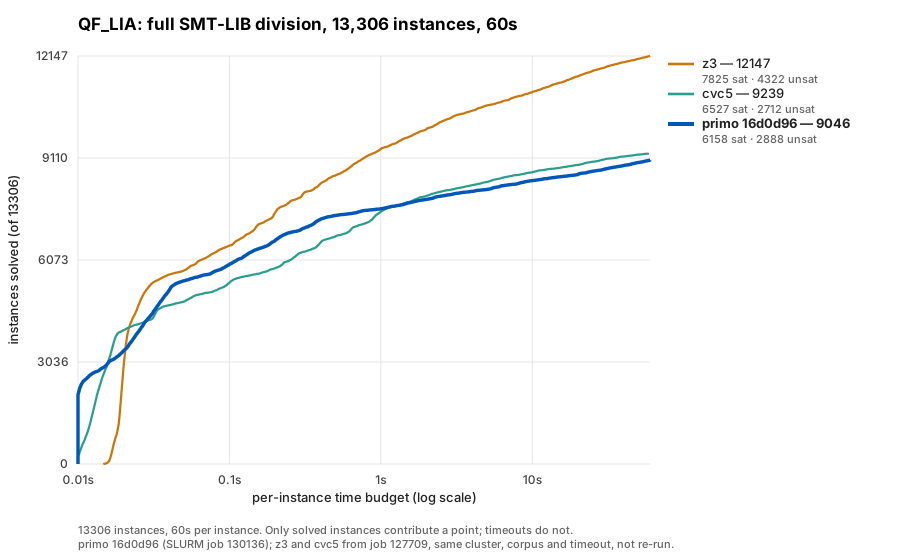
Fig. 3 Instances solved against the per-instance time budget, whole division, nothing filtered out. Legend entries carry each solver’s sat/unsat split below the total.#
The archived Primo arm solves 466 more inputs than cvc5: 532 more UNSAT and 66 fewer SAT. OpenSMT solves 949 more than Primo, split into 231 SAT and 718 UNSAT. Their solved sets overlap on 9,088 inputs; OpenSMT alone solves 1,566 and Primo alone solves 617. The Primo gap to Z3 is 2,439 inputs, split into 1,365 SAT and 1,074 UNSAT.
No arm contradicts a declared benchmark status, and no jointly solved pair disagrees. OpenSMT agrees on 10,450 shared decisions with Z3, 9,088 with Primo, and 8,822 with cvc5. All 6,461 successful SAT rows of the archived Primo arm passed independent Dolmen 0.10 validation; all 128 coverage records and their parent timing/provenance hashes were checked. Model-checking time is separate from the speed measurements. No independent reference-solver model validation is claimed.
OpenSMT’s 21 errors all belong to 20210219-Dartagnan. Every error was
replayed with captured output under the original profile in job 181727:
seven exit-0 non-answers print memory exhausted, and fourteen terminate
with SIGSEGV. Debugger probes of all fourteen place the fault immediately
below an 8 MiB stack mapping, with the stack pointer at its lower boundary,
supporting stack exhaustion. The stripped binary provides no function names;
no function-specific or parser-specific cause is claimed. These failures
remain in the denominator and receive the full PAR2 penalty; none contributes
a cactus point. Diagnostic replay times do not replace the original timings.
Every arm covers the same 13,306 unique relative paths. A post-run content
check matches the OpenSMT corpus against every archived Primo and Z3 input
hash. The older cvc5 arm lacks archived per-input content hashes. Exact
versions, binary hashes where available, commands, runtime distributions,
all 32 family summaries and artifact digests are recorded in
benchmarks/qf-lia-opensmt-20261009.json and docs/run-log.json; the complete
failure manifest and classification are
benchmarks/qf-lia-opensmt-errors-20261009.{txt,json}.
A counting caveat that applies to every QF_LIA figure. Primo exits
cleanly with unknown on 751 inputs here. Counting status == ok would
report 10,456 clean exits instead of 9,705 decisions. Every solved count
requires both status == ok and an answer of sat or unsat; a decision
printed by a process that times out or exits unsuccessfully does not count.
scripts/plot_cactus.py reports clean unknowns and failures separately.
Real-world benchmark evaluation and the fuzzing gap#
Stages 1-3 were each verified via thousands of FuzzSMT-generated cases
(the Fuzzing section above) before being called done, with zero wrong
answers reported every time. A subsequent evaluation against a
size-stratified representative sample of sandbox/non-incremental/QF_LIA
(SMT-LIB’s real-world QF_LIA benchmarks, 13,306 files across 32 families,
428 files sampled) immediately found 11 wrong unsat answers – all in
the convert family (Alberto Griggio’s JPEG/GIF/TIFF converter
symbolic-execution benchmarks, industrial category), all :status sat,
all fast (not timeouts). Root-causing this (see bug 3 under
Where integer strictness actually gets handled
and bug 4 under GCD-consistency) found two soundness
bugs sharing one root cause, and fixing the first of those two exposed a
third, latent completeness/crash bug (see the third fix’s own commit,
“Fix a latent delta-infinitesimal bug in branch-and-bound and Gomory
cuts”) that fuzzing had never triggered either.
Verification after all three fixes. The full convert family (303
files with a declared :status, not just the 428-file sample) re-checked
locally: zero wrong answers. Local FuzzSMT smoke fuzzing (500 default-
parameter cases) and the full Slurm gate (scripts/slurm_qf_lia_model_fuzz_gate.sbatch,
job 127473, 2026-08-20): 3898 PASS, 207 benign timeouts, 3 benign
UNKNOWN_INVOLVED, zero wrong answers, zero crashes, zero model errors –
see docs/run-log.json’s 2026-08-20-qf-lia-real-world-benchmark-evaluation
and 2026-08-20-qf-lia-scale-canonicalization-fix-slurm-verification
entries for the complete record, including job 127465’s failure (23
solver-error crashes from the delta-infinitesimal bug above) on the
first fix alone, before the second fix landed.
Why FuzzSMT’s existing gates never found this. contrib/src/fuzzsmt’s
own QF_LIA defaults (FuzzSMT.java, the QF_LIA case in its
per-logic parameter table) are maxNumVars = 3, maxNumConsts = 3,
maxBW = 4 – every generated integer constant is a random BigInteger
with 1 to 4 bits, i.e. magnitude at most 15. None of the fuzz gates run
so far (stages 1-3’s own verification, all using these defaults) ever
override -Mbw/-Mv/-Mc. The convert family’s actual trigger –
scale-canonicalization (item H1b) dividing by a large leading-variable
coefficient (2^32 for these bit-position-weighted terms, from
(* sigma_N (- 4294967296))-shaped polynomials) – is essentially
unreachable at maxBW = 4: the largest possible scale is 15, giving a
denominator far too coarse to reproduce the same failure mode. Confirmed
empirically, not just argued: 500 cases at the default parameters
against the pre-fix (buggy) binary found zero disagreements (matching
every prior stage’s own “zero wrong” fuzz results, now understood to be a
structural blind spot rather than actual absence of the bug) –
reproduced directly for this section by building the parent commit
(0c8314d, pre-fix) in a separate git worktree and re-running the exact
same FuzzSMT-seeded batch against it.
Widening the bitwidth alone is not sufficient either – an honest
negative result. A second local batch, same seed, with
-mbw 1 -Mbw 32 -mv 2 -Mv 8 -mc 2 -Mc 8 (up to 32-bit coefficients, 2-8
variables and constants, closer to the convert family’s own shape),
run against the same pre-fix binary: still zero disagreements across
500 cases. The bug needs more than a large coefficient in isolation – the
convert family’s actual trigger is many atoms sharing one
scale-canonicalized slack (PreparedLraTheory’s slack_by_polynomial
dedup) via proportional polynomials with a range of small, close-together
thresholds that collapse together after the large-scale division (see
bug 3’s writeup). That combination – proportional compound polynomials
recurring across many atoms in one instance – is a natural consequence of
a real symbolic-execution encoding (many byte/bit-position comparisons
against the same underlying value) but is comparatively rare for FuzzSMT’s
independent, layer-by-layer random atom generation to produce even with a
wider coefficient range, so it did surface as a crash on the new binary
during this same wide-bitwidth batch (see the third bug/fix above) but
not as the original wrong-answer bug on the old one, in 500 cases either
way.
The actionable gap – closed 2026-08-20. scripts/slurm_qf_lia_model_fuzz_gate.sbatch’s
own comment had already flagged this direction as “natural future work
once real QF_LIA benchmarks are collected” back when stage 1 shipped; this
evaluation made it demonstrably load-bearing rather than hypothetical.
Real QF_LIA benchmarks are collected now (sandbox/non-incremental/QF_LIA),
and the same pattern scripts/build_fuzz_seed_corpus.py already
establishes for QF_LRA now has a QF_LIA counterpart: a generated (not
committed, same as QF_LRA’s) seed corpus at
benchmarks/seeds/qf_lia_division covering all 32 families including
convert, an opfuzz task and two YinYang/typefuzz tasks added to
scripts/slurm_qf_lia_model_fuzz_gate.sbatch alongside its existing
FuzzSMT-only stage, and restricted mutation configs
(benchmarks/fuzz-configs/qf_lia_{operator_mutations,typefuzz}.txt) –
see Fuzzing above for the full setup and a first Slurm-scale
run’s results.
Tests#
tests/unit/rational_tests.cpp:floor()/ceil()/is_integer()(stage 1) andgcd()(stage 2), including the big (mpq_class) representation path for each.tests/unit/lra_atom_tests.cpp: confirmsnormalize_atomstays sort-agnostic (anIntLtatom comes out exactly like aRealone) – see the bug writeups above for where the actual integer-strictness handling lives instead.tests/unit/lia_branch_and_bound_tests.cpp: white-box tests ofbranch_and_bounddirectly againstLraTableau– no branching needed, one branch to a solution, every branch infeasible (Unsat), and the node-limit/incompleteness case above. Unchanged by stage 2 on purpose: it exercisesbranch_and_boundin isolation, bypassing the new GCD pre-check, to keep that class’s own behavior pinned down independently.tests/unit/lia_gcd_consistency_tests.cpp(stage 2): white-box tests ofgcd_inconsistent_rowdirectly againstLraTableau– the motivating2x-2y=1row, the same row in its scale-canonicalized (fractional coefficient/bound) form, a coprime-coefficient row that must not false-positive (the critical soundness check – a false positive here means reportingUnsaton something satisfiable), an unfixed (bounded-but-not-fixed) row that must be skipped, a trivial coefficient-1 row, and a row fixed to zero (always achievable regardless of coefficients).tests/unit/lia_gomory_cuts_tests.cpp(stage 3): white-box tests ofapply_gomory_cutsdirectly againstLraTableau, using the two hand-verified worked examples above – an all-J⁺row and a mixedJ⁺/K⁻row, each checked semantically (does the resulting tableau correctly exclude the exact fractional vertex the cut was derived from, and correctly admit the nearest genuine integer point, rather than asserting on the cut’s exact internal coefficients) – plus a case where the cut alone provesUnsat(variables fixed so the cut’s own slack is forced outside its new bound), a row with one term sitting strictly between its bounds (must be skipped entirely, not partially cut), andcut_limit=0as a guaranteed no-op.tests/unit/qf_lia_solver_tests.cpp: black-box, end-to-end viacheck_sat_smtlib, covering the same shapes through the full frontend plusdistinct, nested/nontrivial branching, the strict-tightening bug above exercised end to end, the frontend rejections (UF/Real-under-QF_LIA/division/Int-under-other-logics), (stage 2) bothgcd_inconsistent_system_is_unsat_without_branching(the motivating case, nowUnsatimmediately even under a node limit far too small for branch-and-bound alone to ever reach it) andgcd_uncatchable_divergent_system_hits_the_node_limit(the4x+4y in [2,3]case neither GCD-consistency nor Gomory cuts catch, confirming the node limit is still reachable and the remaining incompleteness is real, not a leftover artifact of an unexercised code path), and (stage 3)gomory_cut_resolves_what_branch_and_bound_alone_cannot(the3x+5y=7, x,y>=0case:Unknownunder--lia-branch-limit 1with cuts off,Unsatwith cuts on, at the same branch budget).