

Arithmetic engineering and retained evidence#
Arithmetic development produced both implemented mechanisms and rejected alternatives. The current Real, integer, preprocessing, and combination chapters own the algorithms. This page records the associated decisions without treating historical timings as current qualification.
Mechanism and evidence map#
H identifiers come from the original heuristics register; they are not API names. All named run IDs below are in the run ledger.
Mechanism |
Current explanation |
Retained evidence and decision |
|---|---|---|
H1 direct bounds and shared polynomial rows |
LRA preparation and normalization |
H1 design and comparisons retain the incremental design progression; do not combine its differently configured promotion bars. |
H2 small rationals |
LRA exact-number representation |
H2 ablation preserves the allocation motivation and measured comparison. |
H3 sparse entering selection |
LRA sparse pivoting and finite fallback |
H3 investigation separates entering-variable sparsity from the optional leaving-variable choices. |
H7 fixed-basic elimination |
|
|
H8 sorted row merge |
LRA sparse row update |
|
H9 bounds-only rollback |
LRA backtracking; SOI exception |
H9 evidence preserves its exact earlier baseline; basis and assignment need not be restored when bounds are undone. |
H10 occurrence maintenance |
LRA affected-row maintenance |
|
H5 phase hints |
Initial local diagnostic and fuzz records are separate from |
|
SOI and its repairs |
LRA objective, breakpoint walk and conflict explanation |
arithmetic history and paper deviation map distinguish the optional algorithm from the default repair loop. |
Integer patching, GCD, cuts and branching |
LIA chapter and its preservation map |
The original integer record retains the scaling/auxiliary/infinitesimal defects, mutation failures, and later repair gates; early clean random campaigns did not cover all real-seed shapes. |
Integer-driver model audit (7 October 2026)#
The model-coverage audit for candidate 25b44cc is complete. It reconciles
successful SAT measurements with separate Dolmen replays of the same binary,
input hashes and solver options. The audit checks exact shard and row coverage,
replay identities, process exits, and saved assertion/model hashes. Timing data
and PAR2 remain unchanged.
Measurement scope |
SAT measurements |
Direct Dolmen passes |
Explicit syntax exceptions |
|---|---|---|---|
Full QF_LIA, two rounds |
13,187 |
13,187 |
0 |
Full QF_UFLIA, two rounds |
814 |
814 |
0 |
Preservation profiles, reruns and probes |
584 |
564 |
20 |
Previously audited lost-case reruns |
50 |
50 |
0 |
The 20 exceptions are LRA inputs whose constant-denominator syntax Dolmen rejects under their declared logic. Dolmen accepted the same saved assertions and models with its logic setting widened to QF_NRA. A fresh recheck records the validator executable hash and exact command. These remain separately classified; they are not direct passes under the original logic. Across the selected records there are no missing SAT measurements, invalid models, or changed replay answers. Repairing 21 failed setup attempts supplied 213 of the preservation passes above; their original failed attempts remain available.
The recorded-reference join found 20,796 agreeing full-corpus measurements and no disagreements. Another 261 measurements, representing 138 distinct inputs, have no decisive recorded reference answer. The join includes completed rows from an interrupted cvc5 campaign for answer comparison only. Model checks do not certify UNSAT answers, and missing reference answers are not counted as agreements.
This closes the outstanding model-coverage reconciliation, not the migration’s
performance acceptance. The repeated prp-67-50 cutoff loss and the recorded
small-suite runtime flags remain as previously measured. Generated and retained
session gates retain their separate audits. Exact commands, hashes, resources,
SLURM jobs and artifact locations are recorded in the run ledger under
2026-10-07-integer-model-coverage-audit, linked to
2026-10-06-integer-completion-unification.
Different routes can justify different choices#
At 3c2fbf1, the model-phase/monotone comparison recorded 1,655 default QF_LRA
solves against 1,678 with model phase, with 34 gains and 11 losses. Mixed Real
results lost three solves with model phase. QF_LIA gained 178 and lost 137,
for a much smaller net gain. These are configuration-specific historical
results, not a universal speedup or a reason to change today’s defaults.
Likewise, the H7 pure-LRA result does not determine its mixed-theory default. Keep route, binary, input set, timeout and correctness coverage attached to each conclusion. Historical local or incomplete-sanitizer checks remain such; they are not rewritten as equivalent to later cluster gates.
Combination evidence#
The general-component migration record
retains paired QF_UFLIA runs, family results, fuzzing and separate model checks.
The Real coordinator record and
2026-09-16-qf-uflra-forced-equality-extraction / ...-forced-equality-merge
retain their own revisions and comparisons. Generalizing the Real route remains
an open implementation lead, not a consequence of those evaluations.
The combination regression investigation is a dated incident and diagnosis. It must not introduce the current chapter as though the original regression were still an untriaged defect.
Published results and unresolved provenance#
The published QF_LRA report preserves its tables, cutoffs, hardware and configurations. Exact table-to-run mappings are still missing. They belong in the evidence work list, with the missing commit/manifest/command/artifact identities stated explicitly. Matching a corpus size or option pair is insufficient to infer a run identity.
Main/migration integration qualification (27 October 2026)#
The combined implementation keeps the automatic QF_LRA policy from main, the migration’s shared assignment and integer drivers, and the separate default-off equality experiment. CPU SLURM qualification passed all 45 release tests, 45 ASan tests, 269 Python tests and 12 documentation examples.
Across 11,000 generated inputs/sessions, 10,985 passed and 15 QF_LIA cases timed out at five seconds; these timeouts remain incomplete. All 16 original seeds and 212 real-seed mutants agreed with Z3. Dolmen accepted all 20,950 selected ground/session SAT models, including the additional LRA and mutation checks. Quantified models were not independently validated. The 800 bounded-budget replays also passed their accounting checks, reporting expected resource exhaustion separately. Generated templates repeat; distinct-input counts are reported per route.
The qualification report
and ledger run 2026-10-27-main-migration-merge record the frozen native source,
binary hashes, exact coverage joins, limits, seeds, jobs and retained setup
failures. Static analysis still reports 18 inherited analyzer diagnostics and
409 include-cleaner advisories. These bounded correctness checks make no new
full-corpus performance claim. The separate 1,200-second campaign remains on
its frozen 4419dc9 implementation.
Migration-branch option ablation#
The October 10 recheck compares the migration implementation with both options
still off by default. Four profiles use the same binary: default, model phase,
monotone elimination, and both. The earlier October promotion on main measured
a different implementation and does not qualify the combined implementation.
The full 1,753-instance corpus is the primary target for default selection and regression assessment. Competition-selection results are supplementary; this campaign does not select a competition portfolio. On the full corpus, both flags together lead with 65 additional solved inputs and an 18.7% PAR2 reduction.
The driver and SLURM wrapper record binary and input identities, exact arguments, CPU and allocation metadata. Generated answer/model gates and tracked regression seeds precede timings. The timing sets are all 1,753 QF_LRA inputs at 30 seconds and the 519-input competition selection at 1,200 seconds. Each profile’s successful SAT rows receive a separate direct Dolmen replay; model checking does not contribute to runtime or PAR2. Generated FuzzSMT model checks explicitly use the QF_NRA semantic superset for constant-denominator syntax; real-corpus validation retains the original logic.
The fresh gates cover 4,000 generated cases per profile and 14,423 direct SAT model checks across the profiles. Independent replay also covers all 3,922 retained mutations per profile. Dolmen and Z3 identify 399 of those inputs as invalid: 314 have unbound identifiers and 85 contain forbidden nonlinear arithmetic. These inputs are recorded by hash and excluded from pass counts; timeout-only rows are also counted separately. The original failed replay jobs and their diagnostics remain in the artifact trail.
The timing pipeline audited all four full-corpus profiles before starting the competition selection. Both timing sets finished before model replay started. Failed dependencies stop later stages, and a hard answer failure detected by the guarded wrapper cancels its timing array. Timing, model, selection-reference and paired-loss audits have completed.
Both timing arrays and all separate SAT-model audits completed successfully on
the frozen 4200525 binary. The solver sources are equivalent to df42f03.
The measured results are:
Profile |
Full corpus solved, 30 s |
Selection solved, 1,200 s |
Full PAR2 reduction |
Selection PAR2 reduction |
|---|---|---|---|---|
Default |
1,466 / 1,753 |
489 / 519 |
— |
— |
Model phase |
1,511 / 1,753 |
501 / 519 |
13.7% |
29.3% |
Monotone elimination |
1,487 / 1,753 |
496 / 519 |
5.2% |
19.1% |
Both |
1,531 / 1,753 |
499 / 519 |
18.7% |
28.5% |
PAR2 reductions compare each profile with default at the same timeout. All 4,779 successful SAT rows across the two datasets passed direct Dolmen model validation, with no answer disagreements among profiles. The selection also matches the input hashes of the stored compute-node reference runs: OpenSMT 497 solved, Yices 489, Z3 476, and cvc5 471. All 28 pairwise joins among the four native and four reference profiles have zero decisive disagreements.
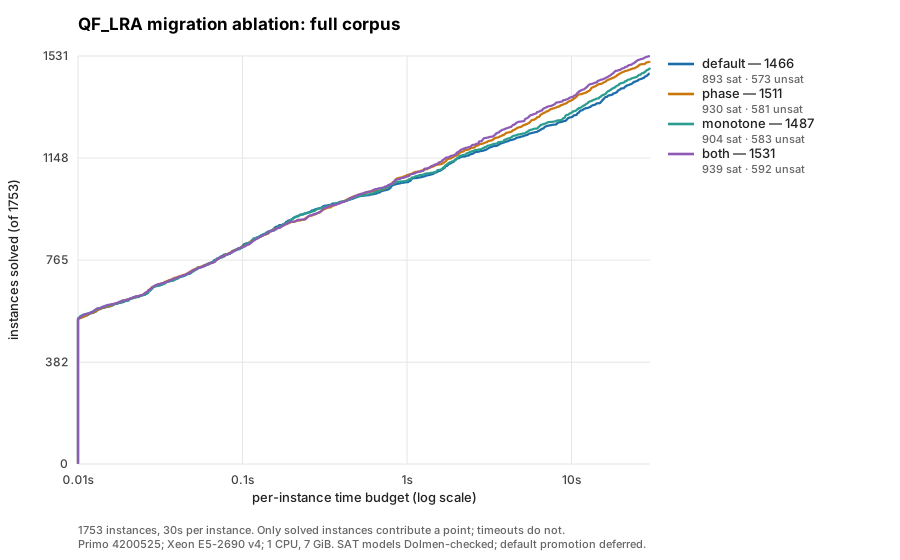
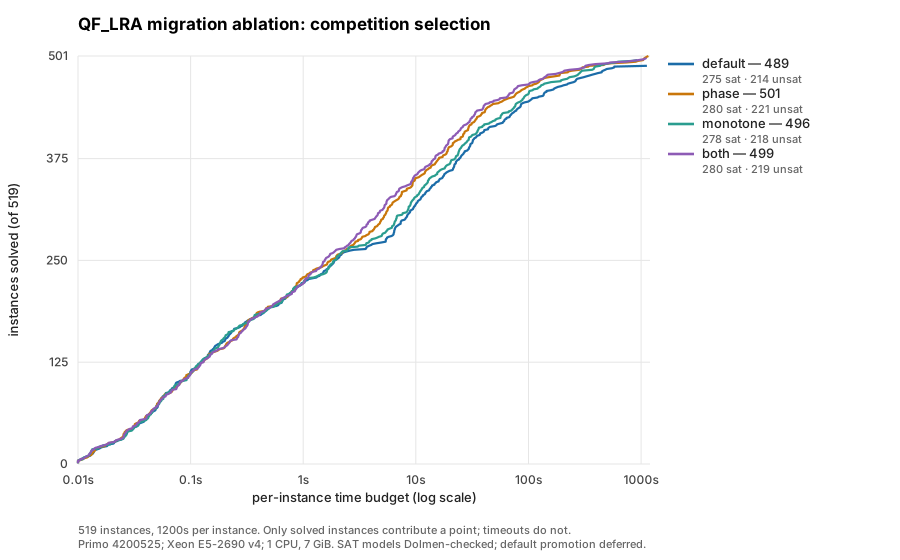
The aggregate gains coexist with repeatable performance regressions. Relative to default, the full run had 28 lost solves with model phase, 9 with monotone elimination, and 23 with both. The paired driver and batch wrapper ran three repetitions of each lost solve on a single physical CPU per pair, with alternating profile order and separate model replay. Full-corpus model replay waited for its three paired timing arrays, independently of supplementary selection reruns. The full-corpus losses classified as follows:
Profile |
Original lost solves |
Lost in all three pairs |
Did not repeat in two or more pairs |
|---|---|---|---|
Model phase |
28 |
24 |
4 |
Monotone elimination |
9 |
6 |
3 |
Both |
23 |
19 |
4 |
All 378 timing parents and their model coverage passed the paired audit. The 127 additional successful SAT rows passed direct Dolmen validation; there were no wrong answers, invalid models, or decisive answer disagreements.
These losses include substantial cliffs. On the full-corpus input
latendresse/ecoliMILPglycerolYices3-5000.smt2, default solved in about 8.5 seconds
in all three pairs while both flags timed out at 30 seconds. Supplementary
1,200-second reruns of that same input still timed out with both flags, while
default took about 8.7–9.3 seconds. This is a repeatable search regression,
not merely variation at the 30-second cutoff.
Both flags were the best aggregate full-corpus profile in this frozen campaign, but that migration revision deferred default promotion while the regressions were diagnosed. The campaign made no solver or default changes. The automatic QF_LRA policy now carried from main has its own qualification record; these timings retain their original profiles.
The 11 October regression investigation collected all four profiles on the 33 distinct full-corpus losses and sampled eight representative inputs. It locates costs in phase-induced arithmetic work, changed search after elimination, and full-tableau violation-set reconstruction on backtracking. It identifies follow-up experiments without changing or promoting either flag.
Run 2026-10-10-migration-lra-option-ablation in the ledger records the completed
timings, complete model coverage and final loss classification. Both options
were off by default in that frozen implementation.
The live ledger remains in use until the separate results-storage migration
is implemented.
Full-corpus comparison with recovered references#
The historical full-corpus reference CSVs are available: Z3/cvc5 job 118382,
Yices 118904, and OpenSMT 119045. Each solver covers all 1,753 manifest
filenames at a 300-second limit. The earlier
reference cactus hid 1,099 inputs
that every solver solved within 10 seconds; its legend therefore counts only
the remaining 654 inputs.

The following plot retains every input and overlays the frozen 4200525
default and both-option Primo profiles with the recovered references. Historical solves
after 30 seconds are censored in derived CSVs; original timing files remain
unchanged. At this cutoff, the counts are Primo default 1,466, Primo both 1,531,
OpenSMT 1,527, Yices 1,525, Z3 1,346, and cvc5 1,209.
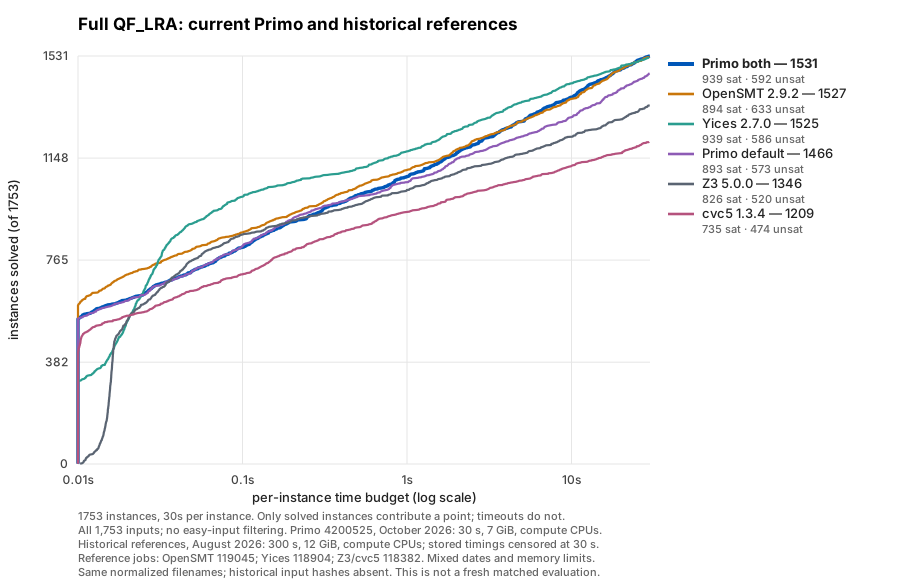
This is a comparison with historical measurements: the references ran in August
with 12 GiB, while Primo 4200525 ran in October with 7 GiB. Both used the CPU
compute partition; recovered accounting places the reference tasks on
node-01 through node-06. All eight profiles have identical normalized
filename coverage and zero decisive disagreements in all 28 pairwise joins,
including reference answers obtained after 30 seconds. The old campaigns did
not record per-input hashes, so byte identity is unverified. Primo SAT
models retain their separate validation; this recovery adds no reference-model
checks. Small count differences between Primo both, OpenSMT and Yices do not
establish a speed advantage under matched conditions.
Run 2026-10-11-qf-lra-historical-reference-recovery records versions, resources,
artifact hashes, audit and plot commands. The
CSV audit/censoring workflow reads existing timings;
downloaded raw data
and derived CSVs are under results/qf-lra-historical-references-20261011/.
Pure-LRA equality propagation experiment#
The October 21 experiment adds the default-off –lra-equality-propagation configuration for diversification. It applies the existing model-unit equality recognizer to comparisons already in a pure QF_LRA input. The paper explicitly disables this discovery pass for pure arithmetic; this experiment changes that scope rather than attributing the setting to its authors.
All four profiles use the frozen 4419dc9 binary and the same hashed 1,753
inputs, with 30 seconds per input, one physical CPU and 7 GiB on SLURM compute
nodes. No GPU nodes or competition subset are used. Here both means
--lra-model-phase --monotone-elimination; equality means the new flag.
Profile |
Solved |
SAT |
UNSAT |
Timeouts |
PAR2 sum, seconds |
|---|---|---|---|---|---|
Default |
1,466 |
892 |
574 |
287 |
21,262.3 |
Equality |
1,169 |
701 |
468 |
584 |
37,381.9 |
Both |
1,533 |
942 |
591 |
220 |
17,185.0 |
Both + equality |
1,175 |
701 |
474 |
578 |
37,515.8 |
The timing audit finds no wrong answers, errors, unknown results or decisive disagreements among profiles. Every successful SAT row passed separate direct Dolmen model replay: 892 default, 701 equality, 942 both, and 701 both/equality, for 3,236 checks in the original input logic. All timing tasks finished before model replay started; checking time does not enter the table or cactus.
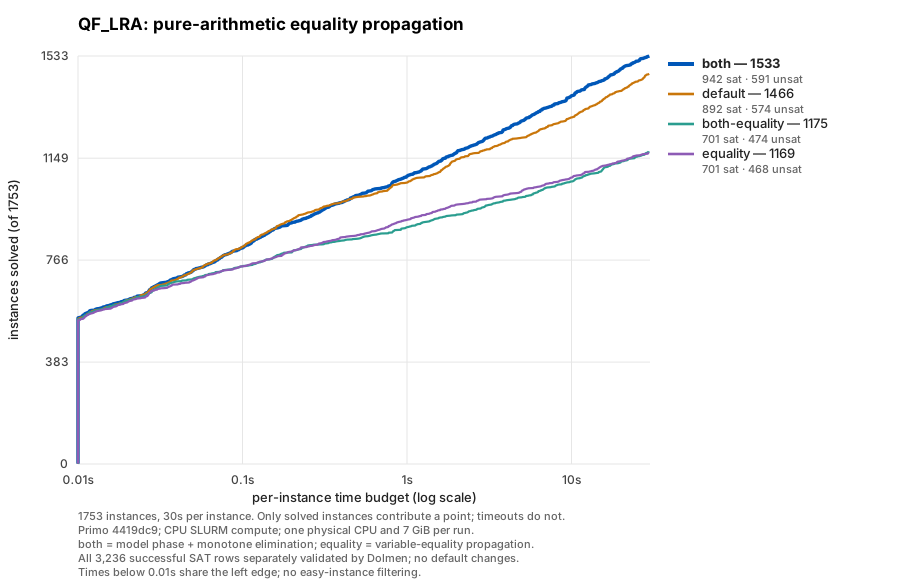
Equality has three gains and 300 losses against default. Both already solves all three gains. Adding equality to both has zero gains and 358 losses. The default/both union is 1,556, and the four-profile union is also 1,556: this run shows no extra solved coverage from the new configuration. These unions allow 30 seconds per configuration; they do not measure a portfolio scheduled within one shared 30-second budget. Equality raises PAR2 by 75.8% against default; adding it to both raises PAR2 by 118.3% against both.
Exploratory censoring of the same timing rows finds small coverage gains at shorter cutoffs. No extra solver runs or portfolio scheduling were performed:
Cutoff per configuration |
Default/both union |
Four-profile union |
Extra inputs |
|---|---|---|---|
0.1 s |
830 |
830 |
0 |
1 s |
1,101 |
1,101 |
0 |
3 s |
1,238 |
1,238 |
0 |
5 s |
1,301 |
1,302 |
1 |
10 s |
1,396 |
1,398 |
2 |
20 s |
1,501 |
1,501 |
0 |
30 s |
1,556 |
1,556 |
0 |
For example, equality solves the Bradley–Manna–Sipma LassoRanker
Iteration1_Lasso_7-phaseTemplate input in 8.36 seconds, versus 19.06 for
both and a default timeout. Its other ten-second addition is
2019-ezsmt/routingMax/SCC_strong/p50.56.smt2, at 7.66 seconds versus
13.60 for both. These observations have no paired-repeat confirmation and
do not establish a useful schedule under a shared budget.
The largest losses are in LassoRanker: default solves 236 and equality 63,
while both solves 296 and both + equality 71 of its 419 inputs. Other affected
families include 2019-ezsmt (90/61 and 94/67), sc (144/116 and 144/107),
and uart (70/32 and 66/31), with each pair showing the profile before/after
enabling equality. All 488 meti-tarski inputs remain solved in every profile.
A separate diagnostic on
2019-ezsmt/travellingSalesperson/rand_70_300_1155482584_11.lp.smt2 locates
the cost in equality discovery. In a five-second counter run, equality spends
4.56 seconds in 13,443 scans, returning 4,304,669 explained edges but delivering
only three target literals. A separate GDB run samples the equality consumer
in 151 of 155 stacks and its tableau producer in 132. These are overlapping
inclusive counts from an instrumented run, not replacement benchmark times.
Repeated scans and unproductive discoveries explain this case’s overhead;
the counters do not establish a general search or pivot pathology.
Correctness qualification also passed 44 release and 44 ASan CTest targets, 242 Python tests, 12 documentation examples, and 18 original seeds in each profile. Each profile received 3,000 generated FuzzSMT cases and 1,000 Boolean/arithmetic cases. Across the status-aware FuzzSMT replays, 83 timeout-only outcomes are separate from passes. There were 14,389 generated SAT-model checks; those from FuzzSMT use the QF_NRA semantic superset for constant-division syntax. Fresh real-seed OpFuzz campaigns produced no bug triggers, and independent replay passed all 3,600 retained files per profile (1,652 distinct contents). Equality-only retained mode passed 1,000 sessions, 11,000 queries and 8,000 direct SAT-model checks. The initial combined-profile assumptions probes hit the existing monotone-elimination configuration guard; that unsupported combination is recorded separately, not counted as a pass.
The campaign driver,
complete-coverage audit,
and diagnostic plan
preserve the profiles and method. Run 2026-10-21-pure-lra-equality-portfolio
records the exact binary, input identities, resource limits, jobs and raw
artifacts under results/lra-equality-portfolio-20261021/final/.
The flag remains an experimental control; defaults are unchanged, and this
measurement supplies no positive portfolio-coverage evidence at 30 seconds.
The small exploratory gains at shorter cutoffs remain distinct from the
aggregate losses and the absence of a measured shared-budget schedule.
Rejected prototypes and unimplemented H4/H6/H11 directions remain discoverable through the research register. Keeping their negative results prevents a later proposal from mistaking an already rejected design for an untested idea.